Jump to content


makeitgo

Member Since 17 May 2011
Offline Last Active Mar 10 2020 04:36 PM

Topics I've Started

Bull Clip Level

28 April 2014 - 03:14 PM

"It hits 9000' FLAT!" - is something we've heard since the dawn of foam flinging. But does it really?

Every one has pondered a way to determine whether or not they or others are actually firing flat. Of course placing an actual level from the tool box is obvious but as we all know, impractical. Especially, if you want to do a test quickly and with various blasters. I know people have duct taped or rubber banded levels to Nerf accessories before but those don't fit well on to home mades which tend to not have Nerf tacticool rails.

Here's a cheap and practical solution: It takes all of 3 minutes (or less) to do and costs about $3.00.

The levels and bull clip were sourced from Dollorama. The levels come in a pack of 2 and the clip came in a bunch of assorted sizes. In fact, everything you see on the counter was bought at Dollarama.

Posted Image

The first thing that you need to do is separate the level from its housing. I just used a set of pliers. Next, just super glue it on to the wide part of the bull clip. There's usually a slight groove along the middle which should help to align it center. ...and you're done!

You now have a level that can be mounted and dis-mounted quickly, virtually anywhere on your blaster. It clips nicely on to the Nerf rails and on to most barrels.

Posted Image

When mounted on the rails, it can double as a pseudo scope.

Posted Image

Posted Image

If you don't like the clip arms, they can easily be removed.

Posted Image

Now, firing level and FLAT can be proved to yourself and to everyone else.

Posted Image

Taking Off Stickers

20 May 2013 - 08:22 AM

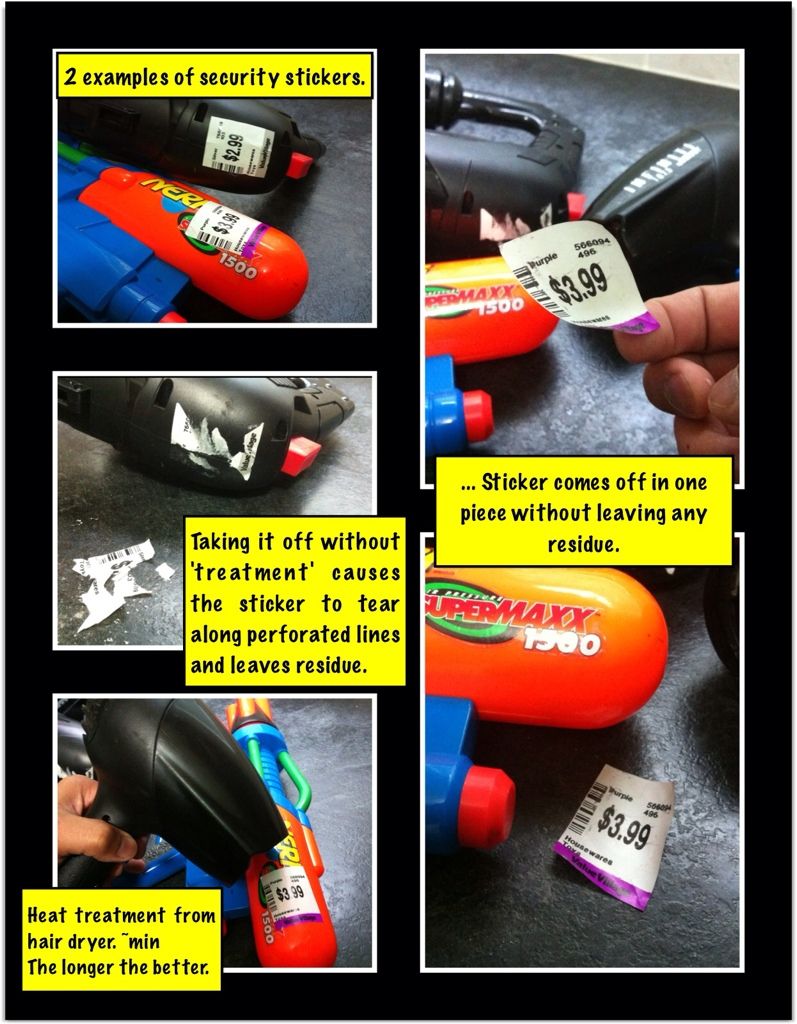
Have you ever had trouble taking pesky stickers off? Well this is a simple Nerf Hack to help.

Posted Image

Using a hair dryer, heat up the offending sticker for a minute or so. Start peeling. Apply more heat as needed. It should come off without too much fuss.


It even works with stock stickers.

*Edit - this method also allows for you to re-use the sticker. So if you're giving it a paint job, you can reapply the stickers if you so choose.

Posted Image


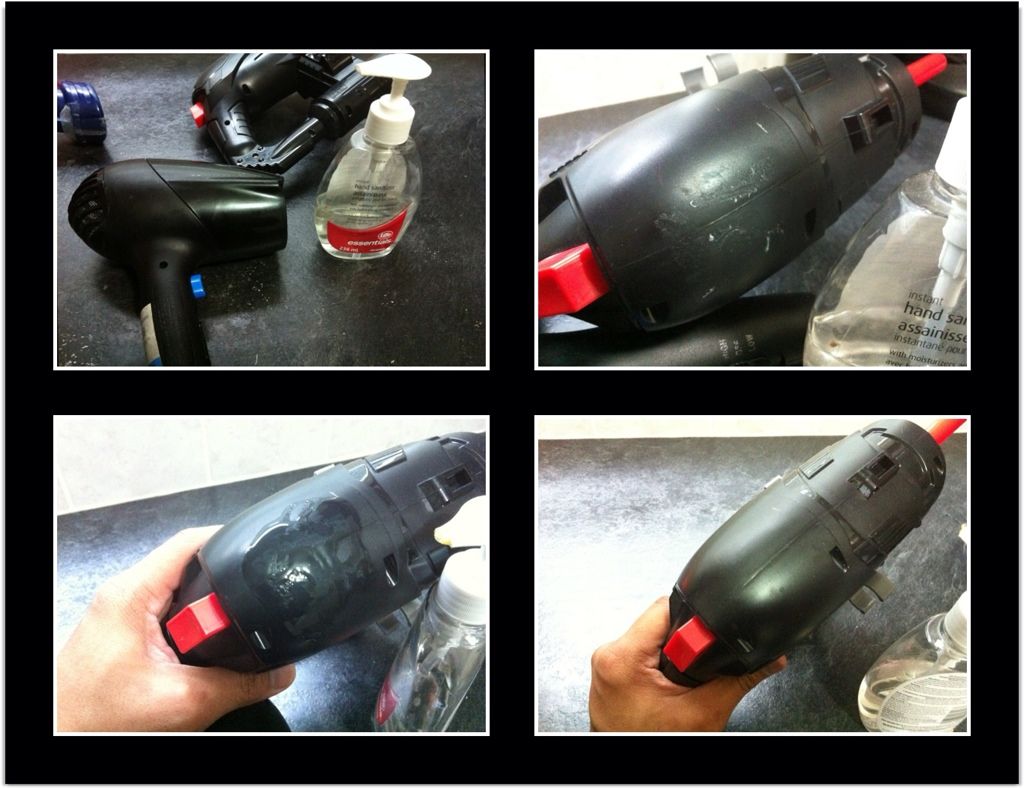
If you do have residue, there's no need for expensive goo-be-gone products. Just your hair dryer and some cheap hand sanitizer.

Posted Image

Apply heat to residue and apply hand sanitizer. Allow a few seconds for the hand sanitizer to react with the residue. Apply a little more and with a little finger muscle, simply rub it off.

Multiple Orgasm - A Guide

11 March 2013 - 03:48 PM

Attached File  IMG_4187.JPG   130.52KB   124 downloads

The initial goal of this home made was to create a compact pump action blaster that retained the performance made familiar by it's popular contemporaries. It's of a Bull Pup design with a familiar 7" draw and more importantly, incorporates a unique pump action system that allows for the familiar and more ergonomic shotgun style prime, without the use of a pully. In fact the only thing different about this system from a 'RainBow Pump' is it's configuration. It is, in essence, a Reverse/Inverse RainbowFire Pup.

I'd like to begin by explaining that the materials I chose to use are what were available to me. Many of you know that I live in Canada and I don't have access to many of the popular materials commonly used for homemades or McMaster Carr. The majority of my materials were sourced from Home Depot, Lowe's, Walmart, the Dollar Store and Pet Smart. I'm sure this can be converted using the popular materials available to most of you ('Merikans).

The name, "Multiple Orgasm", was chosen mainly because it incorporates so many sexy goodies. Namely, the unique priming system configuration I deemed, the G-Spot . And like Zorn's FAL, I felt like adding some estrogen to the database.

So let's begin...

The main things you'll need are three different sized tubes/piping that sheath nicely into each other. In my case I chose:

- 1.5" ABS as my main priming bar
- a 2" gravel vacuum tube (meant for aquariums) for the main plunger tube

- 2" ABS for the shell.


You'll also need:

- 3 cutting boards for the catch, supports, trigger, grip/handle and stock. In my case I chose 2 thinner boards and one relatively thick board. - 2 1/2" elbows (I eventually swapped out one of the elbows for a T)
- 2 stubs of 1/2" PVC


Attached File  IMG_4188.JPG   187.63KB   113 downloads

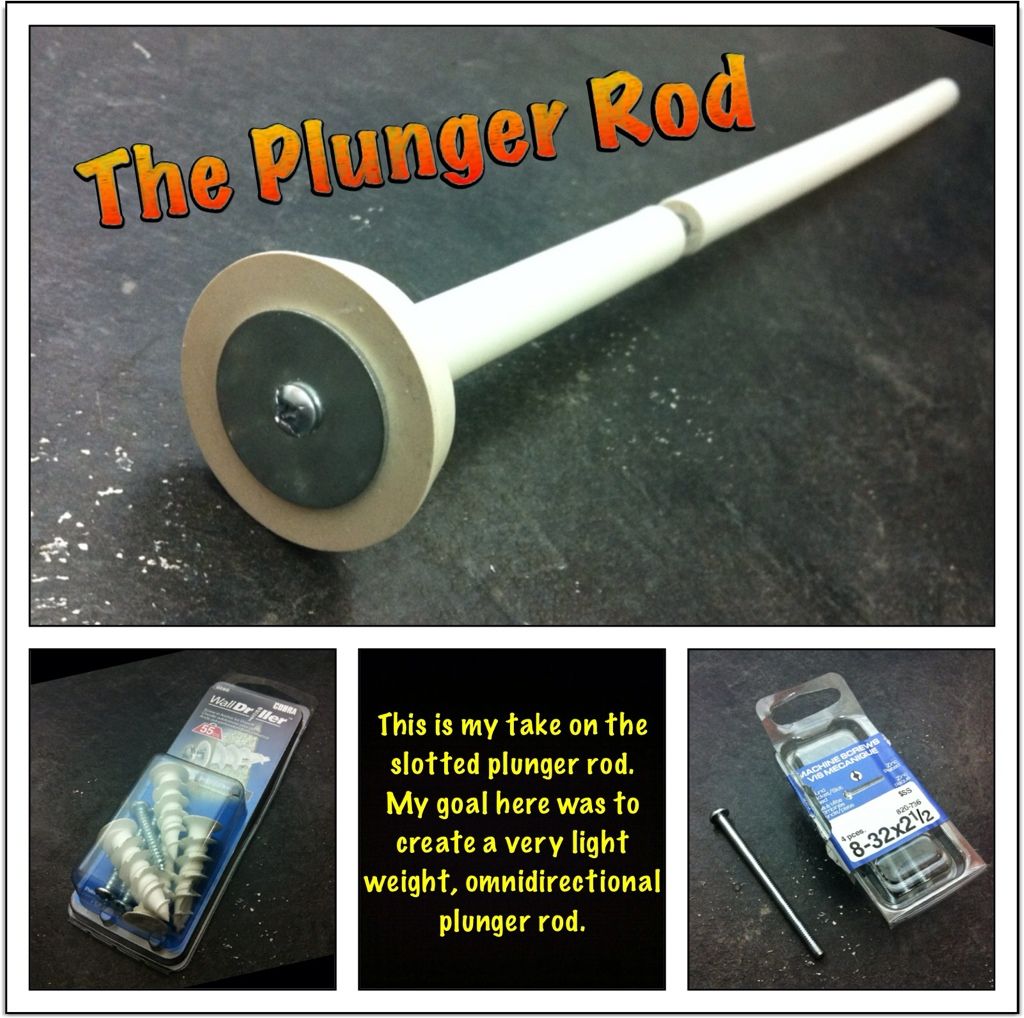
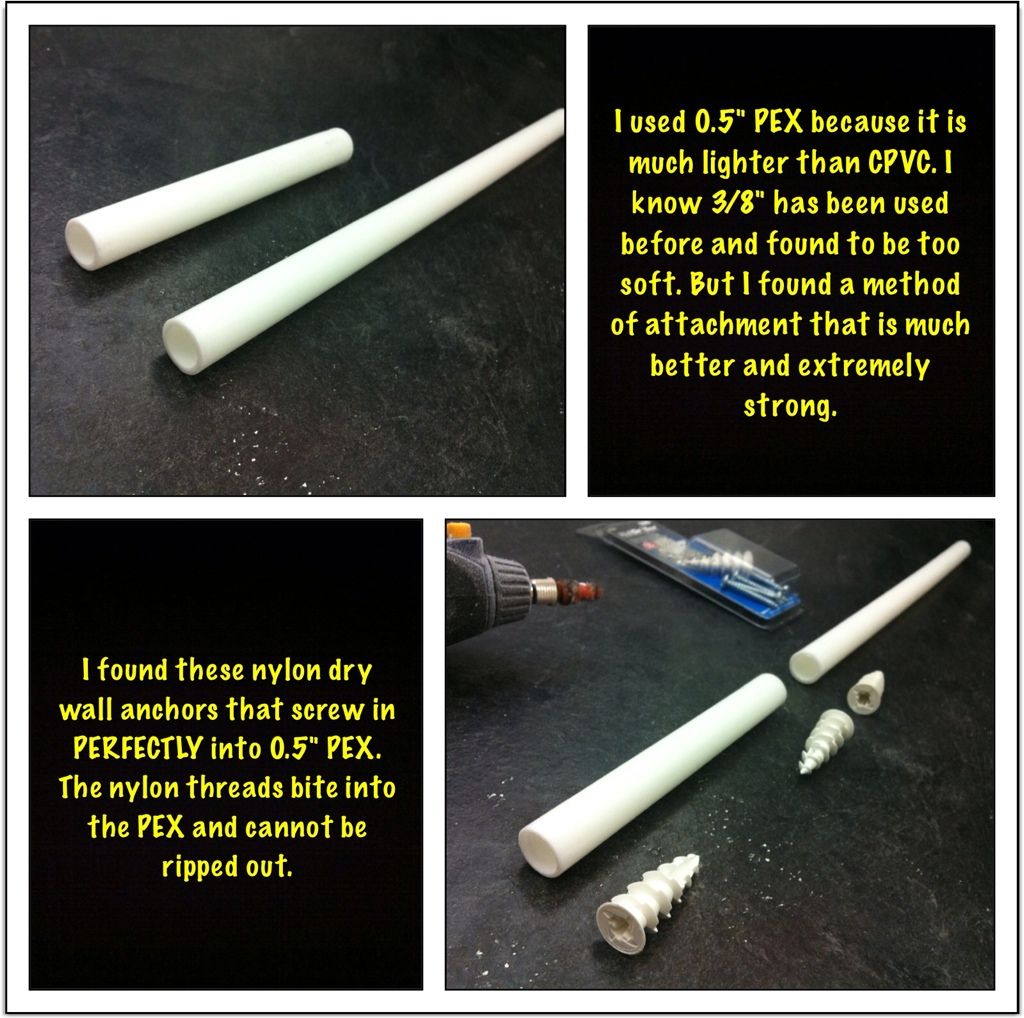
Since this does utilize a slightly modified Rainbow catch, a slotted omni-directional plunger rod will also be required. There are many variations on this but in my case I made mine out of PEX, nylon drywall anchors and a 2.5" 8-32 screw.
 

Attached File  IMG_4191.JPG   150.43KB   103 downloads

Using the thicker of the cutting boards, I cut out the 2 main supports, my catch, and what I needed to create my bushing/coupler. I used a 2 1/8" (54mm) hole saw bit for the larger disks and a 1 3/4" (44mm) hole saw bit for the smaller disks.
 

Attached File  IMG_4189.JPG   145.69KB   109 downloads


*Note that one of the bushing rings is made with the thinner cutting board.

SinceI knew I would be using PEX as my plunger rod, I cut out the appropriate sized holes using a 5/8" stepped drill bit, widening it just slightly after using a Dremel/rotary tool.

Attached File  IMG_4190.JPG   134.93KB   109 downloads

You'll note that in creating the catch plate, I cut off the two sides which are used as the guide and spacers. Please notice that the entire catch assembly has been cut with a 'slope' to accommodate the triggering system.

Let's move on to the plunger rod next. We'll come back the catch assembly as the creation of the plunger rod will make the rest of the catch assembly make more sense once it's created.

Attached File  IMG_4192.JPG   154.02KB   108 downloads

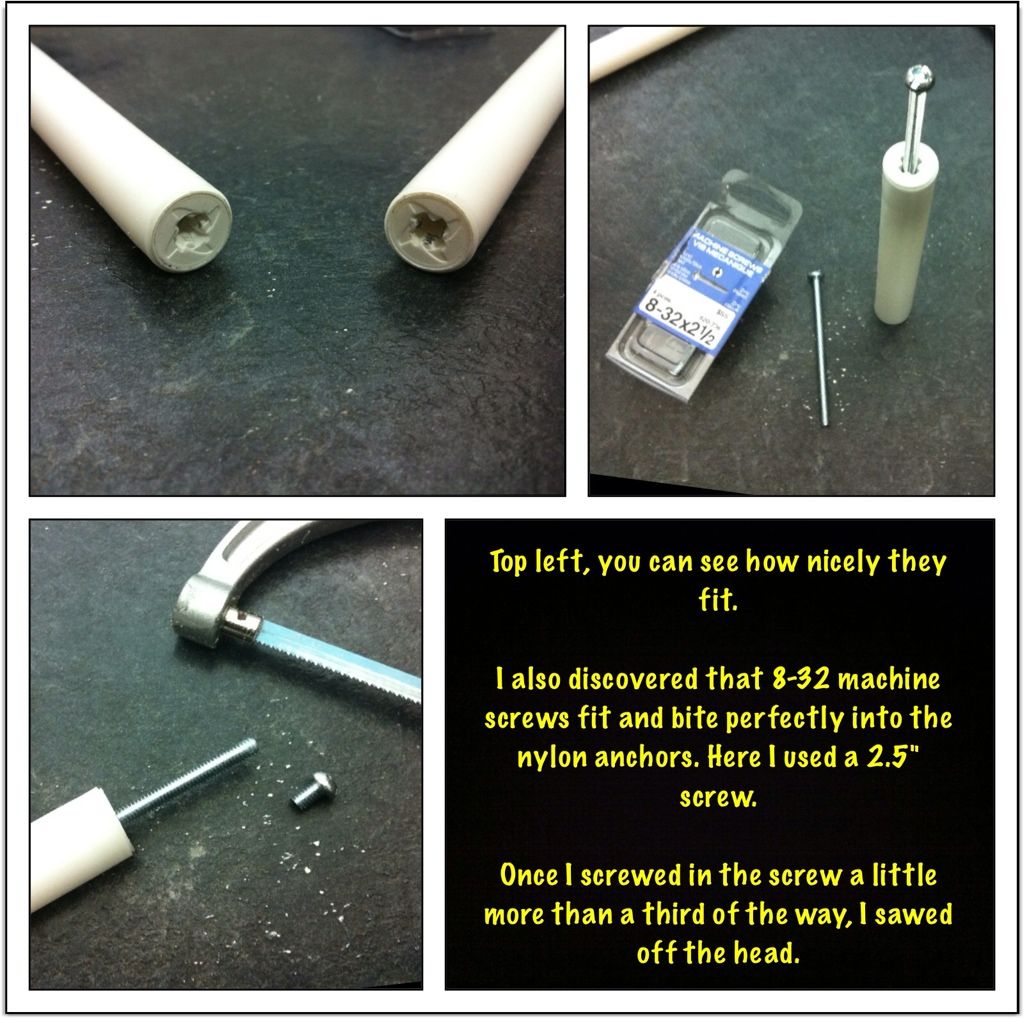
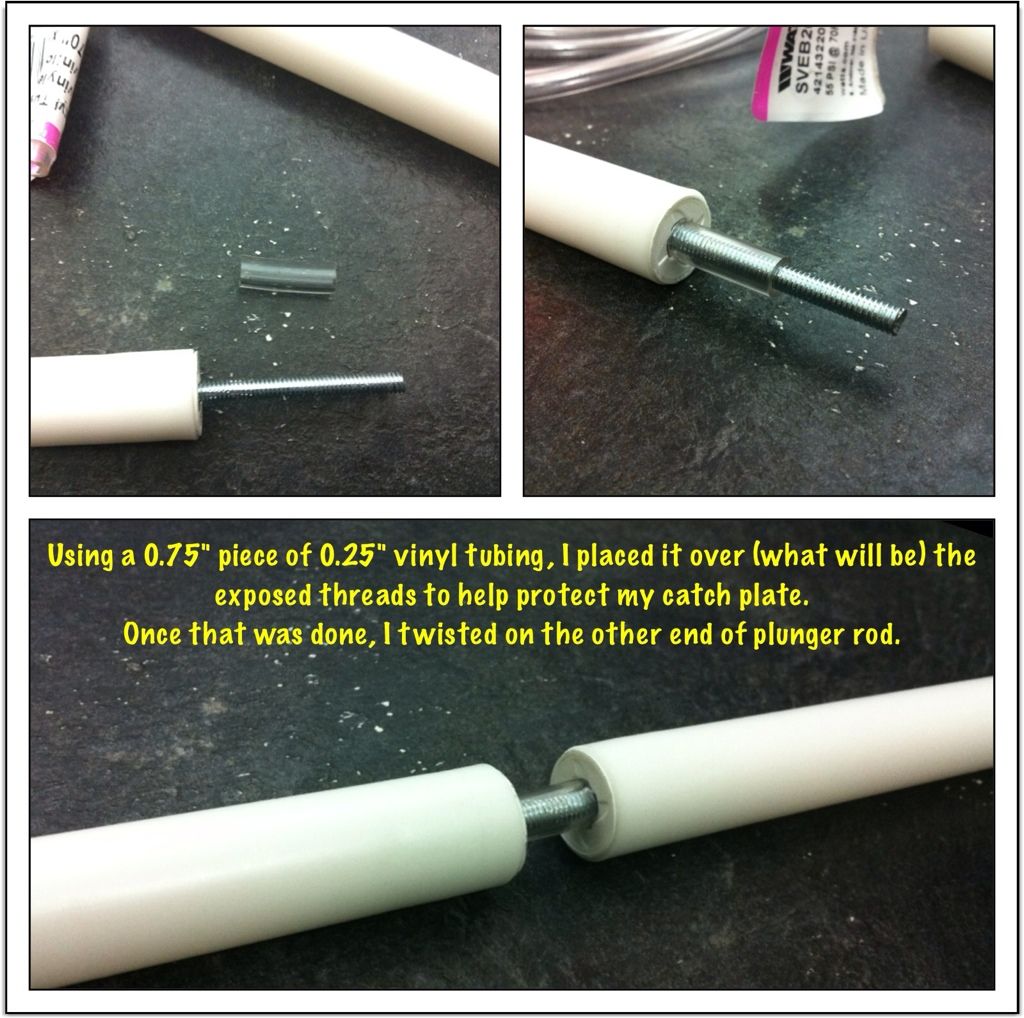
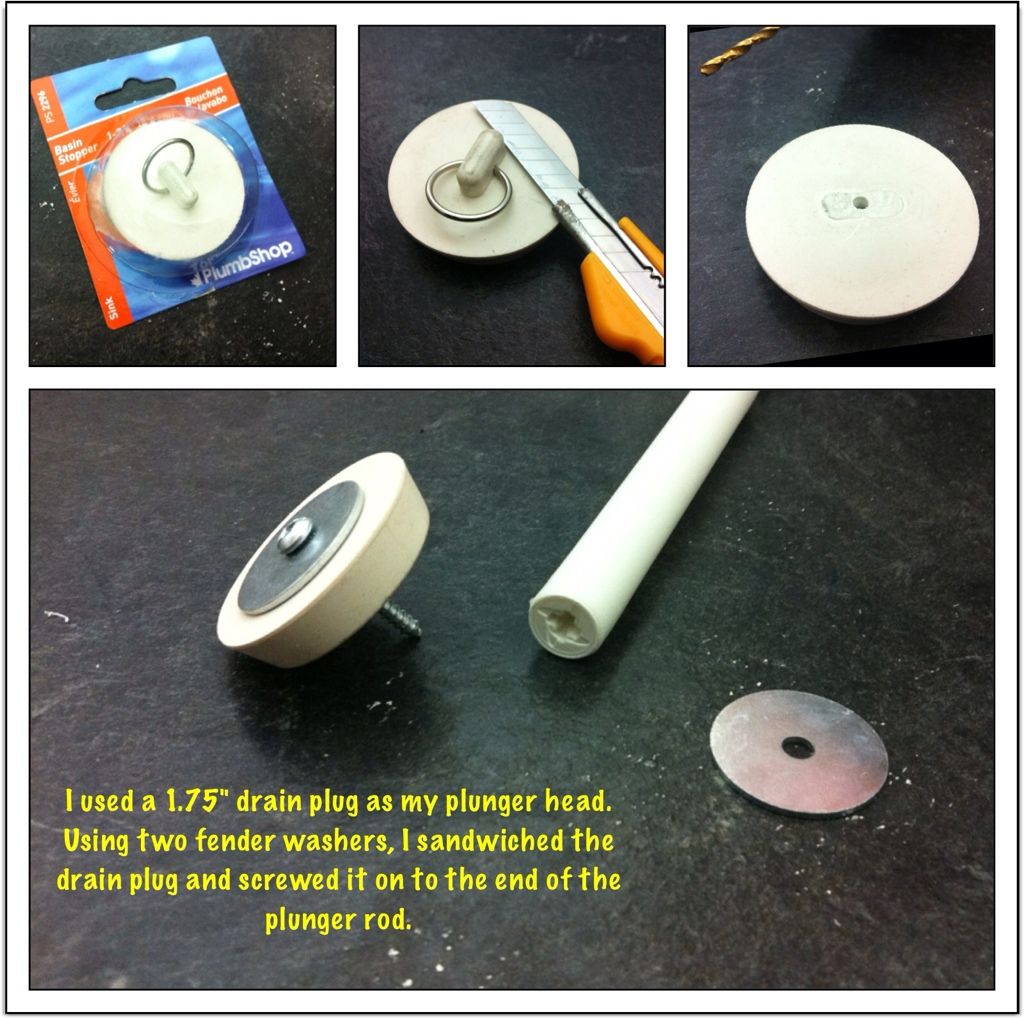
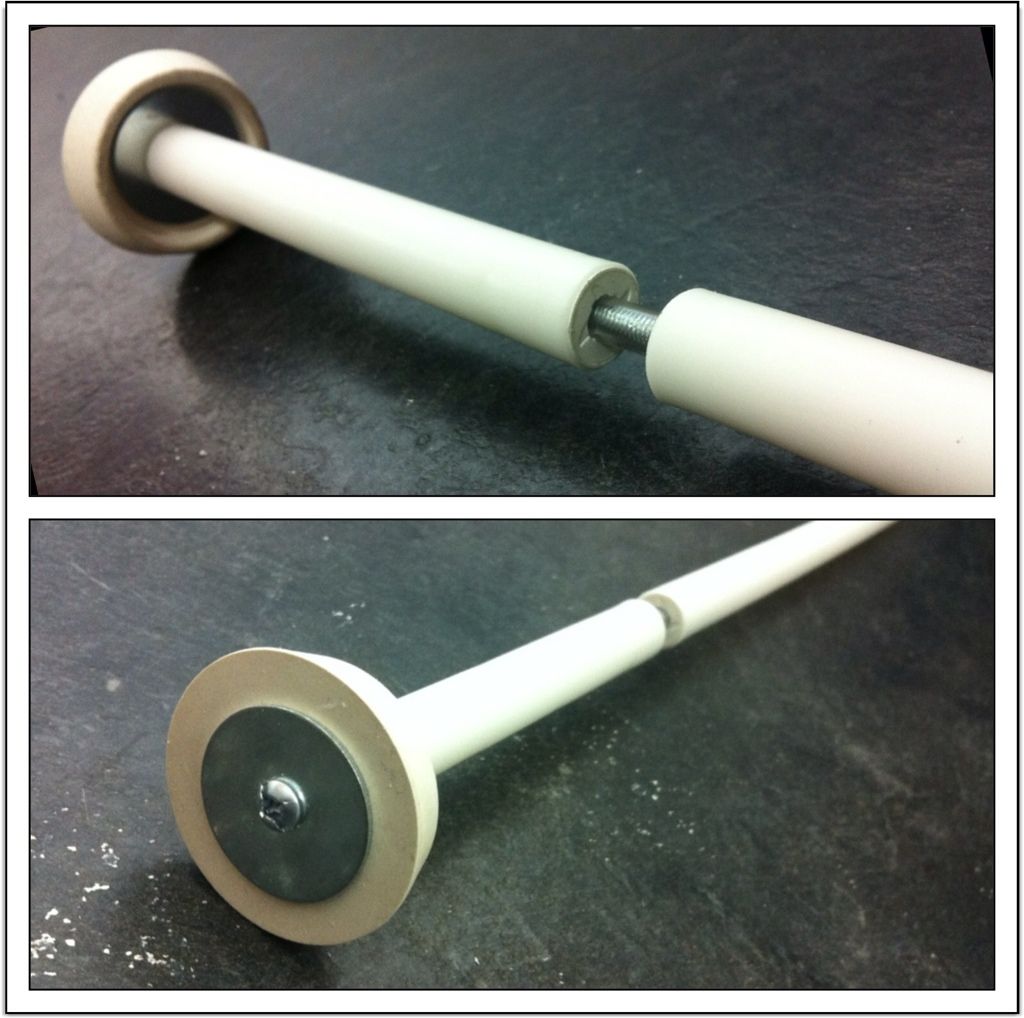
I used a 1 7/8" drain stopper as my plunger head as it fits perfectly into the 2" gravel vacuum tube. I cut both parts of the plunger rod out of PEX who's respective lengths were determined by my spring and it's fully compressed length. The length of the piece closest to the plunger head is 0.25" longer than the length of my spring fully compressed. The latter half is the rest of the length of the spring leading into the catch. Nylon Drywall anchors were screwed into the illustrated ends. The anchors must be new and unused as they need to 'bite' into the interior walls of the PEX. Both lengths are connected via a 2.5", 8-32 screw. Once it was screwed into one end, the head of the screw was sawed off. A 0.75" length of 1/4" vinyl tubing was slipped on to the screw as protection for the catch plate. Then the other length was manually screwed in by hand. This will actually require a bit of wrist strength to get it down so the notch is only 0.75". The pointed end at the tail of the plunger rod was made out of a scrap piece of nylon but it can be fabricated out of epoxy putty. It's secured via super glue and a set screw. It's purpose is to guide the plunger rod through the catch plate. However, this is optional. You could lengthen the end of the plunger rod to already exist through the catch plate. It will become clearer as you read on.

...Now back to the catch assembly.

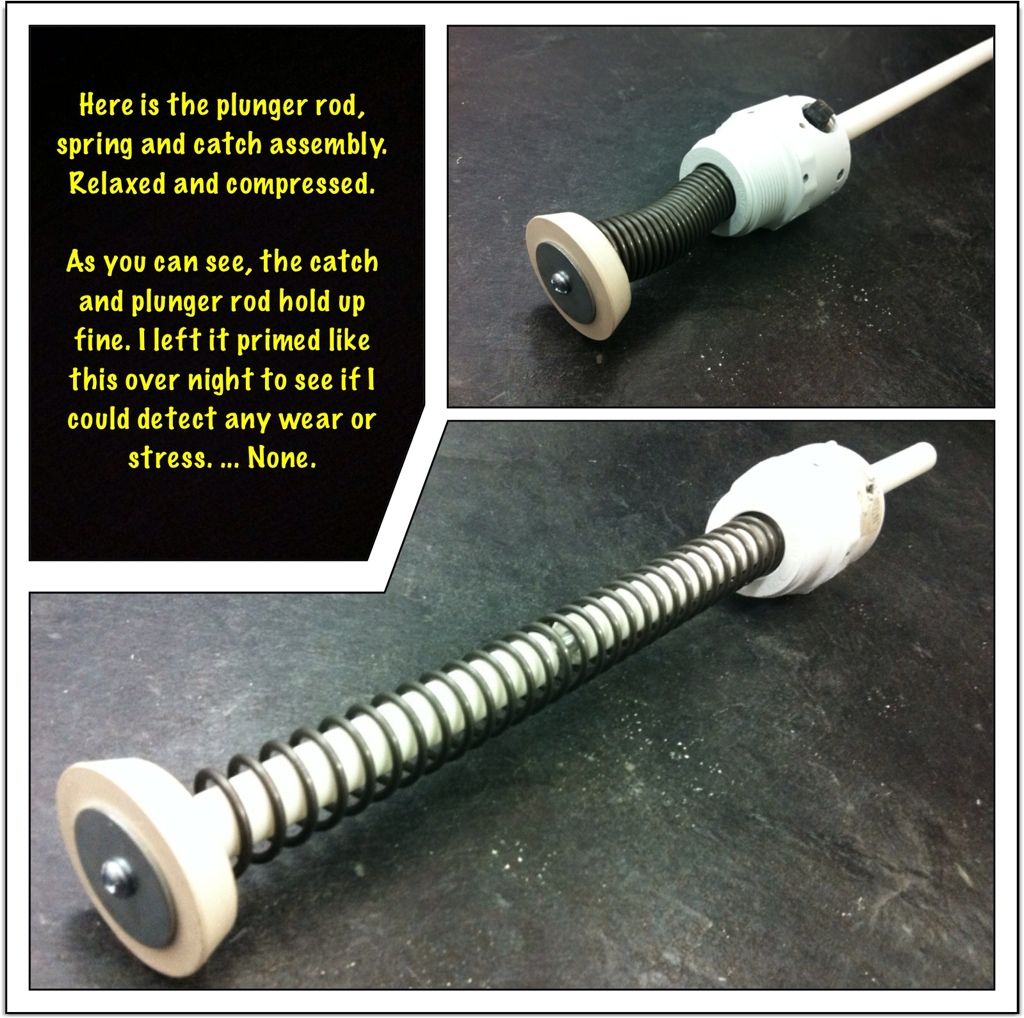
Much like Zorn's Fal catch setup, I shortened the the rear end of the plunger rod by applying that length to the catch via a length of 3/4" aluminium. The length is also the approximate length of the spring fully compressed. *Again, this is optional. The purpose here is to shorten the overall length of the blaster as a whole. Otherwise, a full length plunger rod is all that's required.
I VERY carefully sized the hole in the spring rest to be a very tight friction fit with the 3/4" aluminium. Just as an extra measure, I also used Super glue.


Attached File  IMG_4193.JPG   157.65KB   105 downloads

With quite a bit of sanding, I was able to get the PEX plunger rod to sheath almost frictionlessly inside the 3/4" aluminium. It's important that the spring you use fits over the plunger rod AND the plunger rod sheath. It's also important to make sure that there is very little to no 'wobble' in this set up to avoid the spring 'kinking' and causing problems with the draw.

Attached File  IMG_4194.JPG   141.2KB   119 downloads

Above, you can see that this setup shortens the overall length by at least 4". The 4 extra inches that would have stuck out the other side of the catch has been integrated into the primed portion of the plunger rod.

Attached File  IMG_4195.JPG   144.62KB   104 downloads

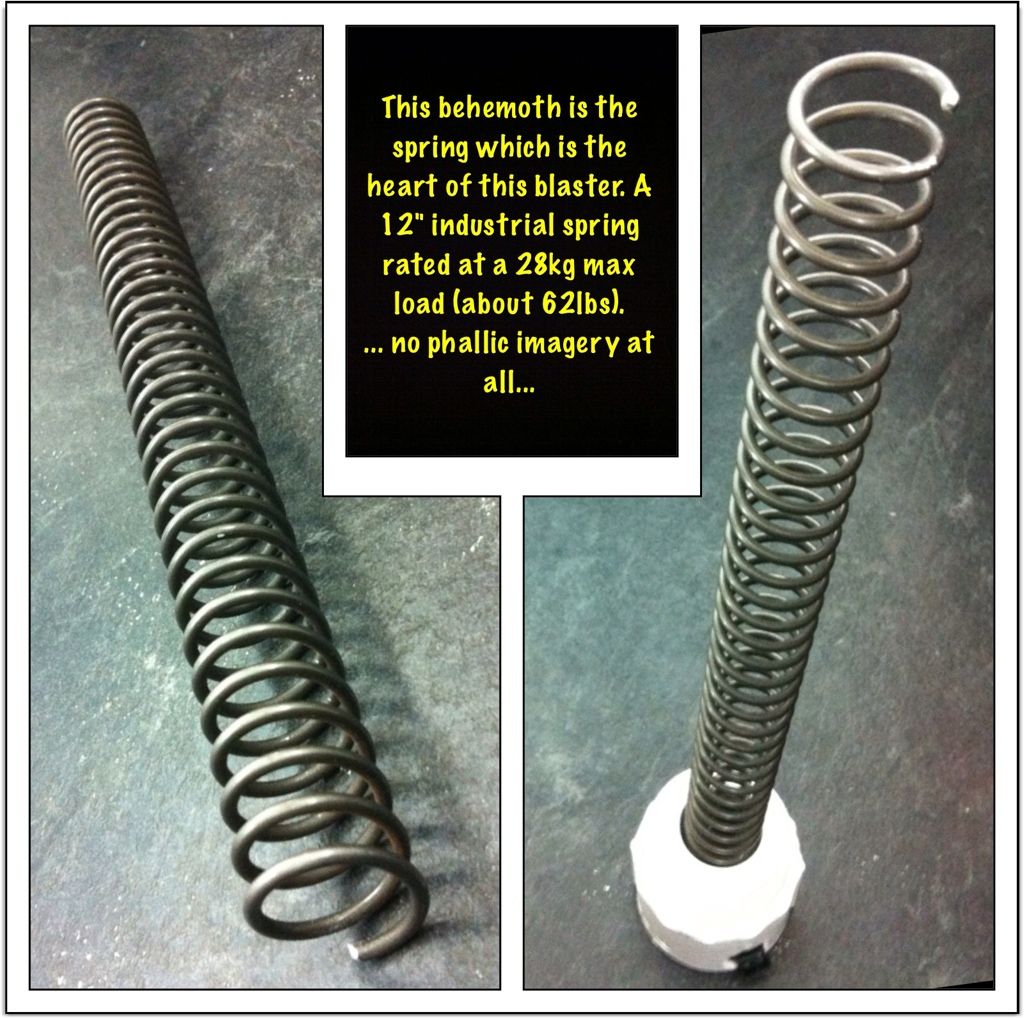
*The spring I'm using is not a [k26]. It's a spring I found locally that is 12" long, has a full compression length of 4.5" and has a max load weight of 28kg (~62lbs.)


And now we move on to the "G-Spot"!


This is where things become reversed and inverted. Normally, what would normally be used as the plunger tube, now becomes the priming bar/tube (1.5" ABS). Instead of the plunger rod facing in, it faces out. By taking the catch out of its normal position, held static inside the plunger tube, and placing it in the priming bar, it becomes mobile. Integrating the catch in this manner solves the riddle of keeping a shotgun style pump action prime with in a compact Bull Pup configuration!

I know it seems complicated, but if you have or have made a Rainbow Pump, this will be easier to understand. If you take your RBP apart, simply turn the catch and plunger rod the other way. Bingo! It's that simple. Your 1.25" plunger tube becomes the priming bar/tube and the 1.5" thin wall most of you use as the priming sheath would now become the plunger tube. The only thing you need now is the shell.... more on that later on.

Attached File  IMG_4196.JPG   147.27KB   104 downloads

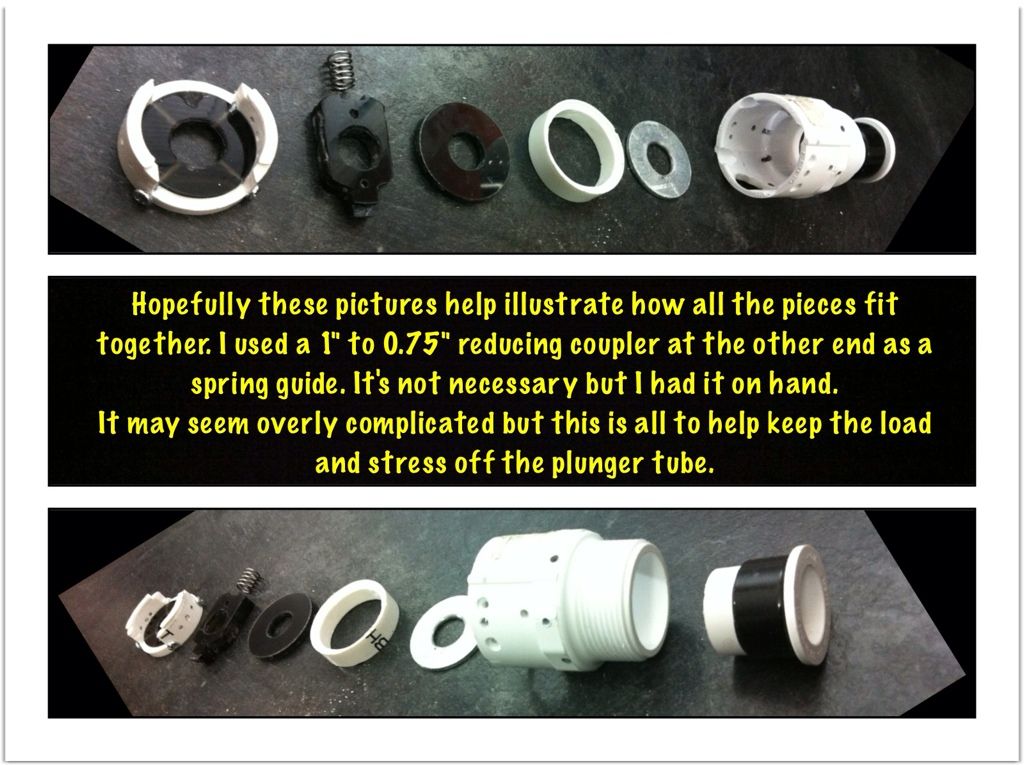
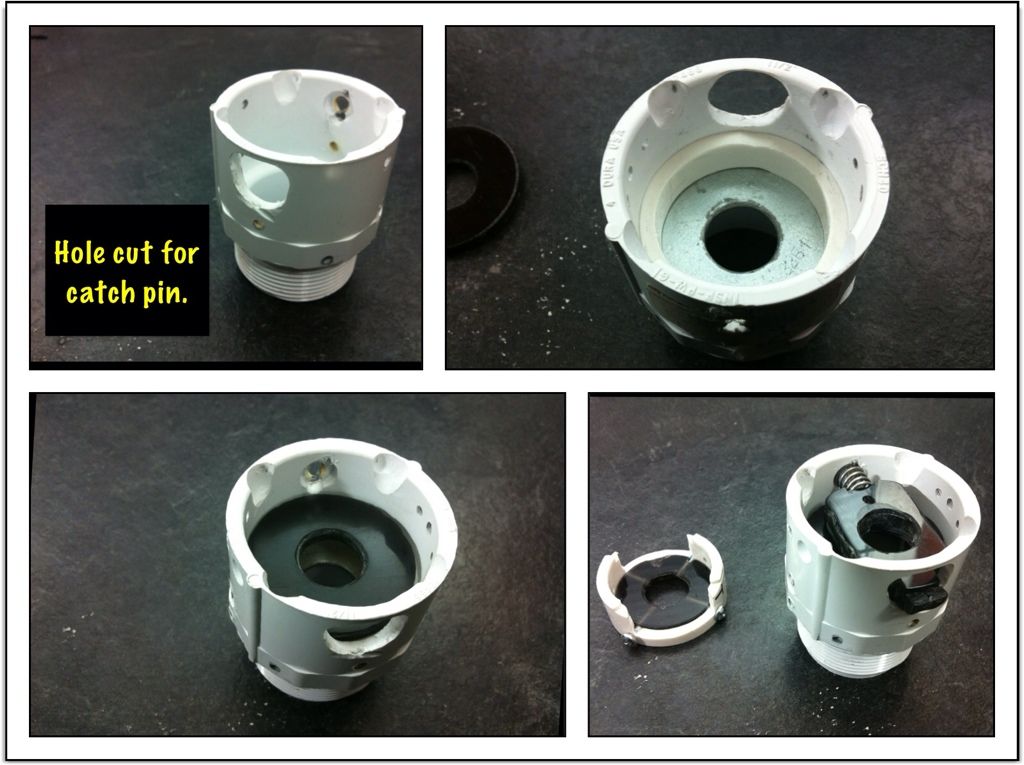
As you can see above, slots have been cut out of my 1.5" ABS. The main slot (the larger one) is there to allow the trigger room to travel along the priming bar without getting in the way. It's made just wide enough for the catch to 'drop'. The extra slots are purely aesthetic. The added length towards the plunger head, which is also the approximate length of the spring compressed, is not all that necessary but does offer assistance in guiding the G-Spot assembly along the plunger canal.

Below are more examples to help you understand the G-Spot better.

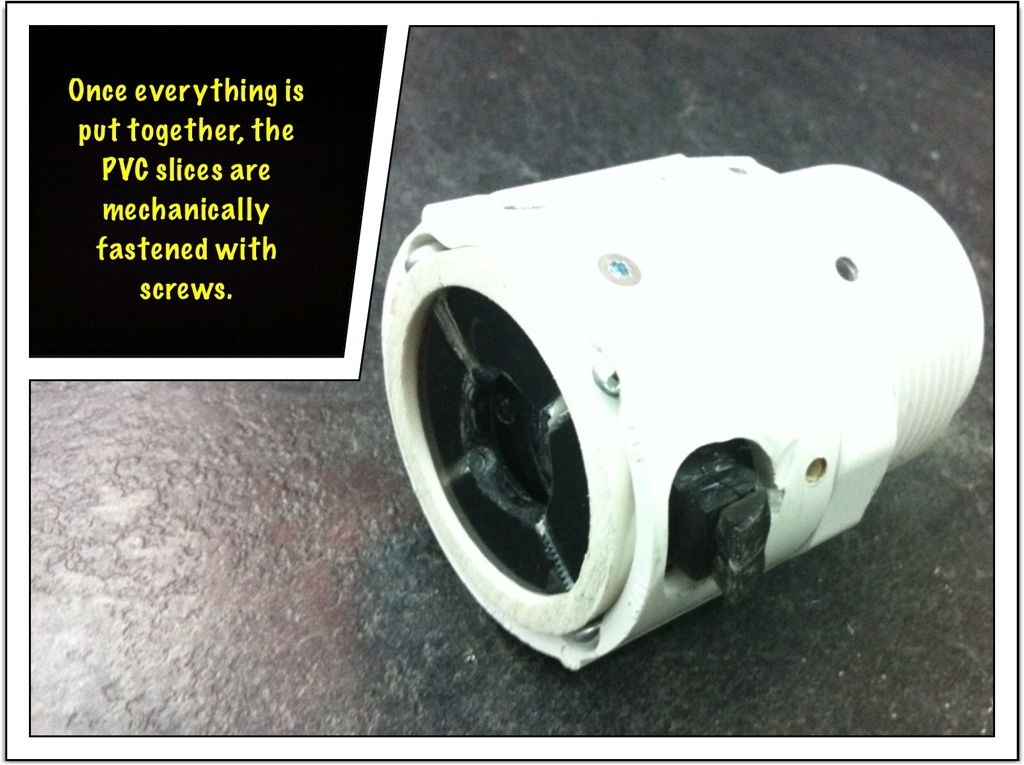
I used set screws to secure everything down. Since this will travel inside the plunger tube, you don't want screws protruding that can potentially scratch up the plunger tube walls. A good sanding to eliminate sharp edges and burrs is highly recommended.
The 2 most bottom pictures illustrate how the assembly looks primed.

Attached File  IMG_4197.JPG   143.01KB   116 downloads


Before we can insert this into the plunger tube, we need to create the bushing/coupler.

If you're using 1.5" thin wall as your plunger tube, a 1.5" coupler would make this a lot easier. However, since I do not have access to 1.5" thin wall, I used a 2" gravel vacuum tube. Which fits very snugly into a 2" VAC coupler.

*note - Even though I'm using a 2" VAC coupler, I could not use 2" VAC tubing for my plunger tube because 1.5" ABS does not sheath into it. But 1.5" ABS does sheath perfectly into the 2" gravel vacuum tube.

Shown below, the three disks I cut earlier, form the bushing plates for my make shift coupler assembly. I cut down my PVC elbows and wye to appropriate lengths to minimize dead space and so that the barrel could rest flush with the shell, once it's all put together.
The natural lip inside the 2" VAC coupler acts the perfect separator for the plates and ensures that they remain centred and square.

The elbow nests very snugly into the centre disk (top right) and is super glued and gooped in. Goop is used in great excess here to ensure a perfect seal. Since the disks war cut with a 2 1/8" hole saw, they have a very snug fit inside the 2" VAC. Once the whole thing was goofed and sandwiched together. I use set screws to secure the last plate.

Note how I carved both the disks and the coupler to be fitted around the elbow.

Attached File  IMG_4198.JPG   139.15KB   118 downloads

Now that we have the bushing/coupler assembly made, we can move on to the main plunger tube.

You've seen some of the pictures below before but here they are again because I know you don't want to scroll all the way up.
The only new picture is the one on the bottom right. It's just there to give you an idea of where we're going.

Attached File  IMG_4199.JPG   155.92KB   111 downloads

Although the plunger tube has already been cut, you can see the necessary slots that need to be made to allow for the priming assembly to function.

In the first picture, you can see how the assembly sits within the plunger tube in its relaxed state.
In the second picture, you can see how the priming assembly is seated in its initial state of prime.
In the third photo, you can see how the entire primed assembly is drawn back to its initial position, ready to fire.

The larger slots are to allow for the travel of the priming handle once it's attached to the priming bar. The drilled holes illustrate the positioning of the priming handle.

Important to recognize; the positioning of the priming handle must NOT be placed too close! I placed it as close as I could to the catch without having to cut slots that would interfere with the active portion of the plunger tube. You can see in the third picture that the plunger head rests just before the slots.

Attached File  IMG_4200.JPG   154.93KB   107 downloads

Attached File  IMG_4201.JPG   143.16KB   109 downloads

The only other slot that needs to be made is the one for the trigger slide so it can hook up inside the plunger tube to flick the catch. The G-Spot, if you will

.... If you haven't guessed by now, holding the trigger down while priming, you rub the G-spot in rapid succession allowing for 'slam firing'!


Attached File  IMG_4202.JPG   184.83KB   105 downloads

Above is just some more images of the main plunger tube with the necessary slots.


And now we move on to the shell.


For my Shell, I used 2" ABS. This is where those who are aesthetically inclined, can get as creative as they want. The main purpose of the shell is to house everything we have just created. It also gives a place to attach the main grip/handle. The only necessary slots to make in the shell are for the priming handle so it can attach to the priming bar and travel its necessary length (7"). And one for the trigger slide.
The extended slots I made are completely unnecessary and only serve to show off the internals. In fact, the priming slots don't need to be as wide as I made them. They only need to be as wide as the area that connects the priming handle to the priming bar. 1/2" at most I would say.

Your shell should be at least 1.5" longer than your internals so you can attach the 'stop' at the front of the shell that keeps the priming bar from shooting out the front. Think of it as the priming rest.

Attached File  IMG_4203.JPG   139.69KB   110 downloads

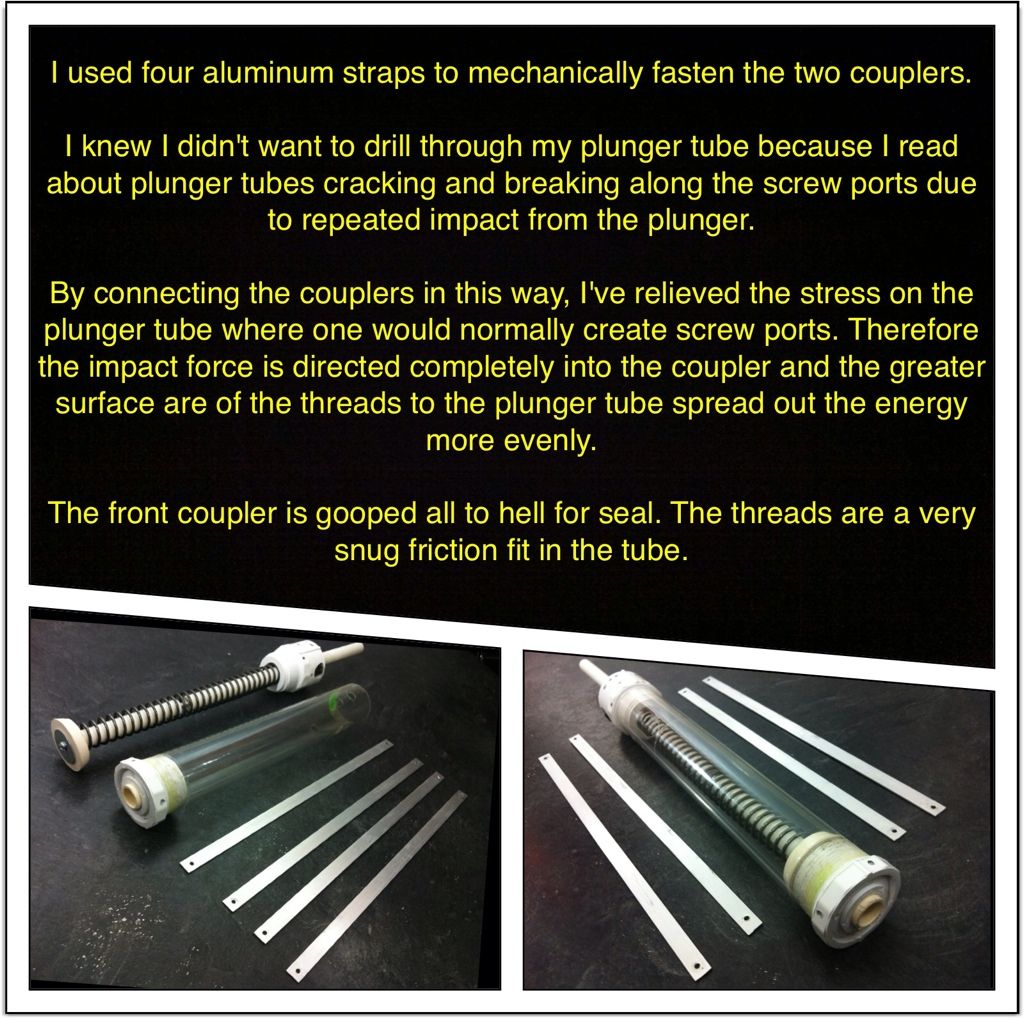
In order for the 2" VAC coupler to fit inside the 2" ABS, I needed to use my 2 1/8" hole saw to bore out the business end so it would fit inside. This made that area relatively weak so I solvent welded four strips of ABS as structural support.

Attached File  IMG_4204.JPG   151.33KB   103 downloads

Attached File  IMG_4205.JPG   148.38KB   112 downloads


The main grip/handle, trigger and stock.


The main grip/handle, trigger and stock are made from cutting boards. The centre spine of the grip is made from the thicker cutting board (Kitchenade). While the two outer halves and shoulder plate are made from the thinner cutting boards (Walmart).

Attached File  IMG_4206.JPG   110.33KB   101 downloads

I measured out the length so the stock would be flush with the back of the blaster assembly. The grip/handle was measured out so that the trigger guard met up with the priming handle. For all intents and purposes, the trigger guard only goes as far as the plunger head after it has been primed. You can see below that the trigger guard lines up with the priming slot.

Attached File  IMG_4207.JPG   131.76KB   105 downloads

Here you can see how the spine is attached to the shell. Access ports were made to help secure the shell to the grip spine. *Note how the screws are counter sunk and flush so as not to injure the plunger tube. There are 2 screws in the front and 3 in the back.

Attached File  IMG_4208.JPG   109.05KB   112 downloads


The priming grip/handle.

My priming grip/handle was made with 2 pieces of 2" ABS solvent welded together. I used 2 because I needed to create a wide enough surface to create screw ports so I could secure it to the main priming bar.

Attached File  IMG_4209.JPG   179.66KB   106 downloads

Once you put it all together, it looks like this:

Attached File  IMG_4210.JPG   115.92KB   107 downloads

Here it is against a Crossbow to show a relative size comparison.

Attached File  IMG_4211.JPG   185.06KB   107 downloads


Pros: All the criteria I set out for were fulfilled.

- Compact design under 24"
- Full 7" draw
- Regular shotgun style pump action prime
- Ranges well over 100'
- Looks bad a$$
- IS bad a$$

Cons:

- It's a little heavy by Nerf standards. But I'm pretty strong so I could deal.
- It can't be de-primed as one would normally de-prime a blaster except by blocking the barrel. Not really a problem since it's so compact.
- The cost. Since this took a lot of trial and error to get it right, I must have spent over $100 to build this. But if I were to do it again, I think the hard costs would still be around $70. However, I do live in Canada so these parts may be a lot cheap for most. Especially those in 'Merika.
- It took a loooong time and a lot of patience and elbow grease. Those of you with actual workshops, I envy you. My workshop is my kitchen and I only have basic hand tools. I have a rotary tool, hack saw, a palm sander, screw drivers and an X-acto knife.... and safety glasses.


POST MORTUM

After doing a lot of testing, I found that the 16" barrel I had initially designed this for, was too short. This obviously has to do with the plunger tube volume. I'm sure if this were down sized to 1.5" PVC thin wall. A 16" barrel would be just the right length, keeping this design under 22". Theoretically, with a full length [k26], this design could be kept under 20"!

I decided to make this a vertical grip since my spring is so strong.

I also added some very tactical elements like a cheek rest and padding for the shoulder stock.
Here you can also see how the VAC assembly is bolted to the shell.

Attached File  IMG_4212.JPG   99.49KB   109 downloads

...but I couldn't stop there. I also swithched out the top elbow for a T and added Blue LEDs.

Attached File  IMG_4213.JPG   130.46KB   103 downloads

As you can see, it lights up internally. Both within the barrel and the plunger tube. No air leaks and no loss of range or power.

...Ohh but wait. I made the cheek rest even more ergonomic. and improved the LEDs.

Attached File  IMG_4214.JPG   132.61KB   108 downloads

When the lights are off, it's even more impressive!

Attached File  IMG_4215.JPG   109.3KB   98 downloads

Attached File  IMG_4216.JPG   90.83KB   107 downloads


....AND


...since this is a feminine themed blaster, why not make it more pleasurable for her with the proper lube.

Attached File  IMG_4217.JPG   138.82KB   113 downloads

Sploooosh!!!!

Yes. I do use this as lube.


Firing Demo


LED Demo


Interesting 1" CPVC coupler find.

05 December 2012 - 05:59 PM

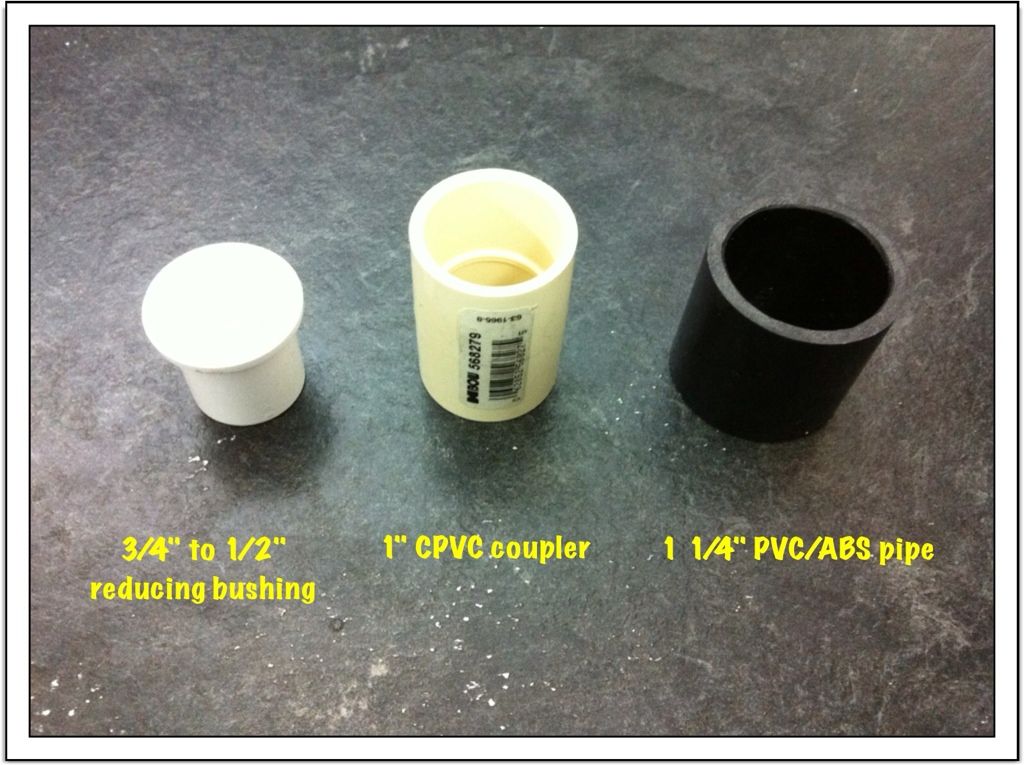
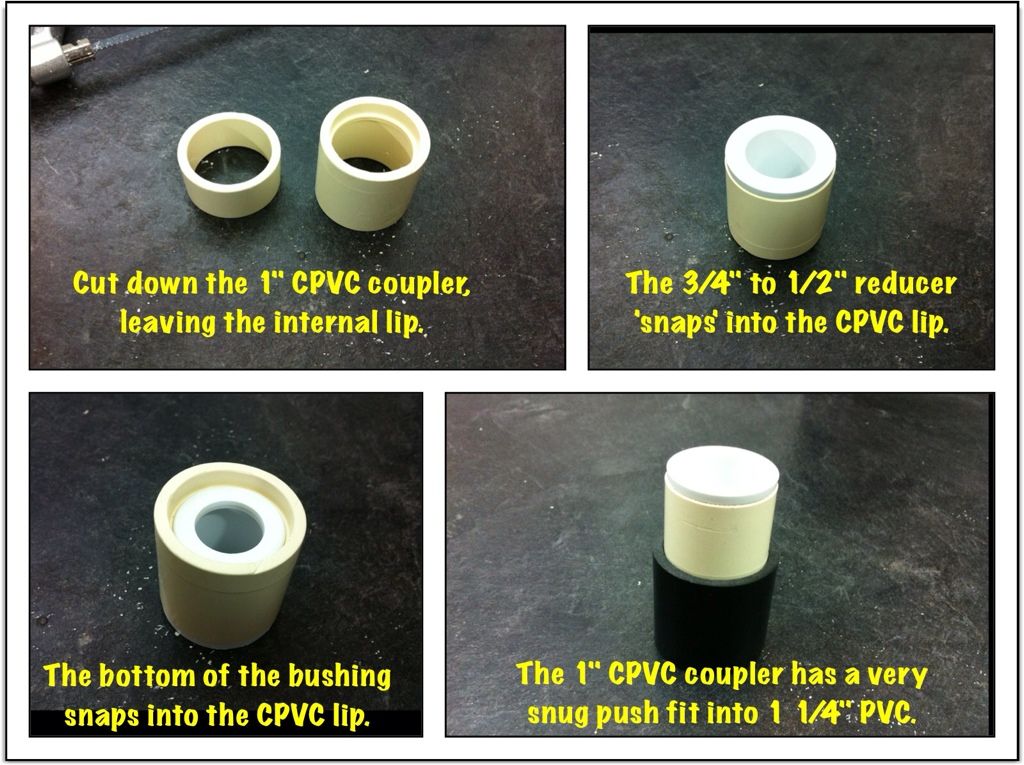
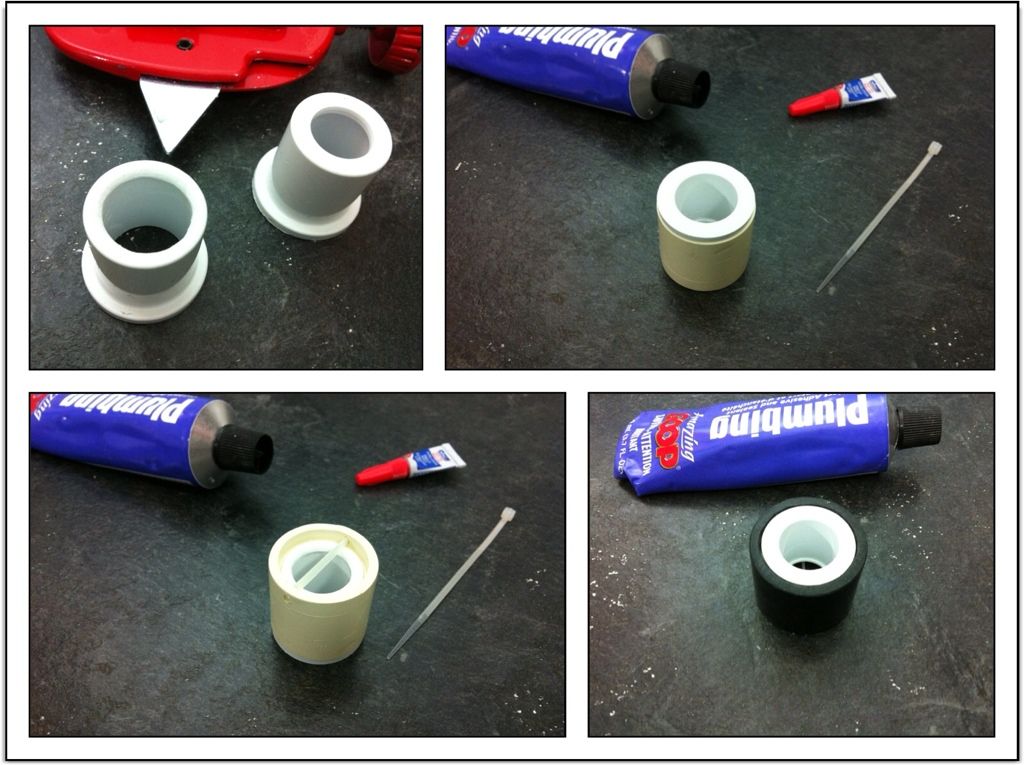
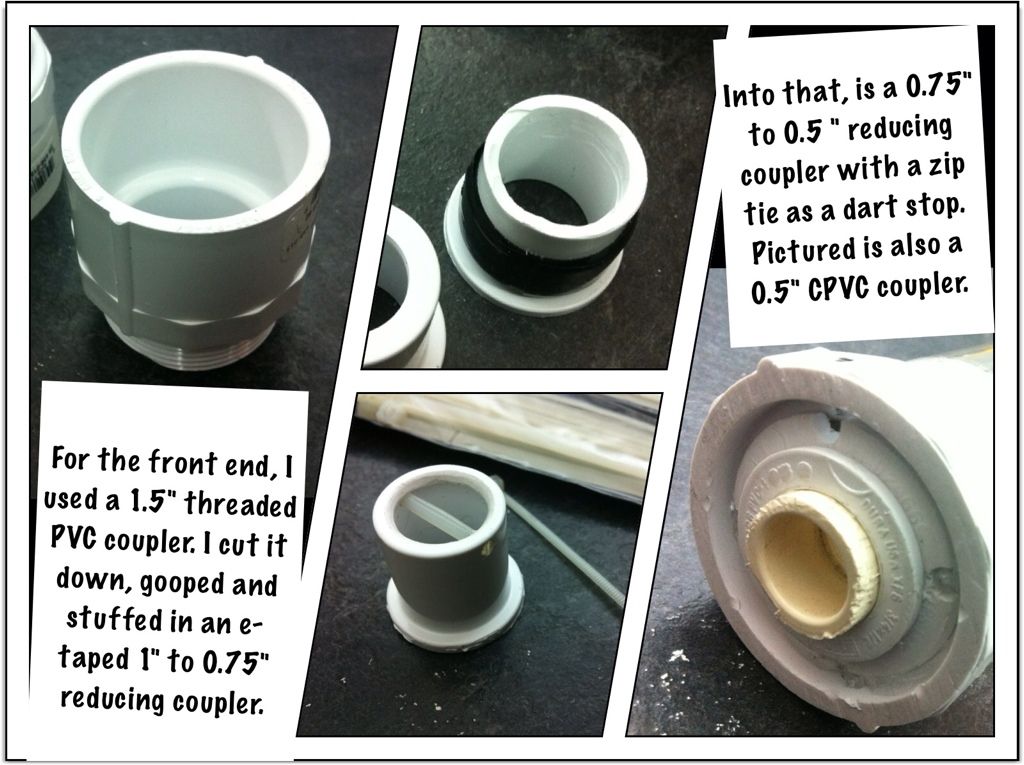
Here's an interesting find that I haven't come across on any of the forums. Normally when people use 1 1/4" PVC for their plunger tubes, they use a 1" to 3/4" reducing bushing and e-tape/packaging tape to create the barrel coupling end.Here's an alternative that doesn't need tape at all, using a 1" CPVC coupler.Posted ImagePosted ImageThe 1" CPVC coupler can be cut down to just before the internal lip. The 3/4" to 1/2" PVC bushing is actually pretty loose inside the CPVC coupler but the internal lip of the CPVC coupler is just wide enough for the PVC bushing to have a very tight fit. I lined it up so the lip catches on the bottom part of the PVC bushing as opposed to the other way around to eliminate dead space and because it centres itself better that way.The really cool part is that the 1" CPVC coupler is a perfect snug push fit into 1 1/4" PVC/ABS. No Tape and perfectly centred. All this, of course, is Gooped and glued into place. From here, mechanical fastening as per usual....Here's some other things I do.Posted ImageI always ream out my 3/4" to 1/2" coupler to create wider air flow and I use a Zip Tie inserted 'edgewise' as my dart stop....and a short clip showing an example of the above.http://s1166.beta.ph...2EC1FC.mp4.html

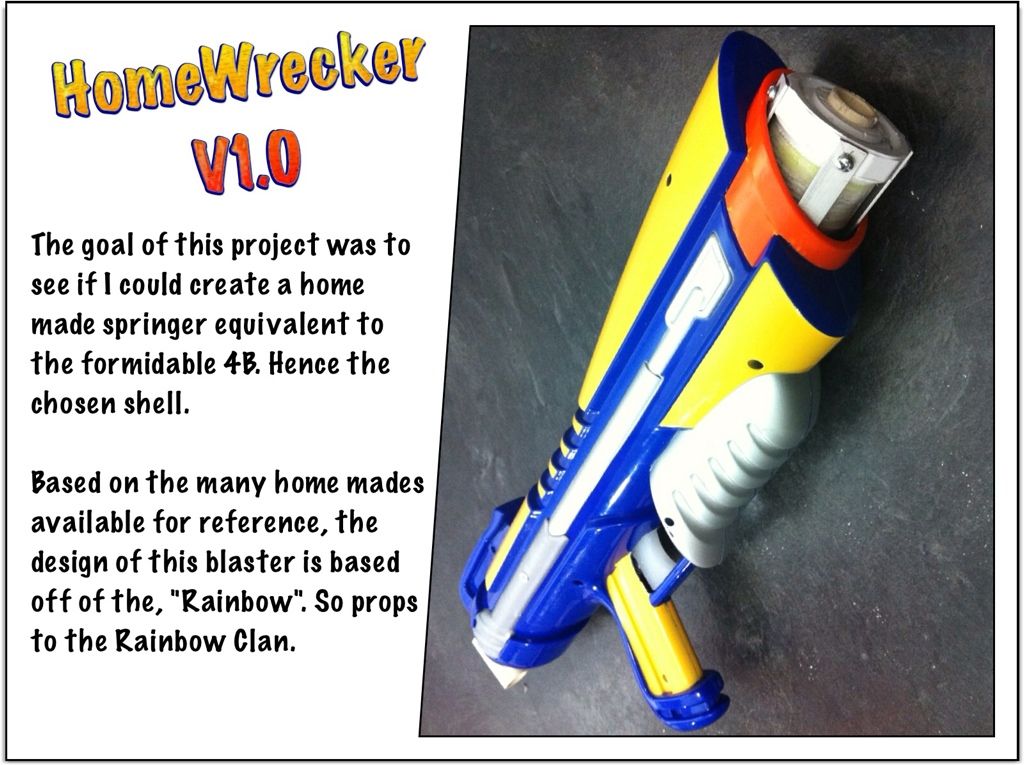
The HomeWrecker V1.0

23 November 2012 - 10:34 PM

Posted Image
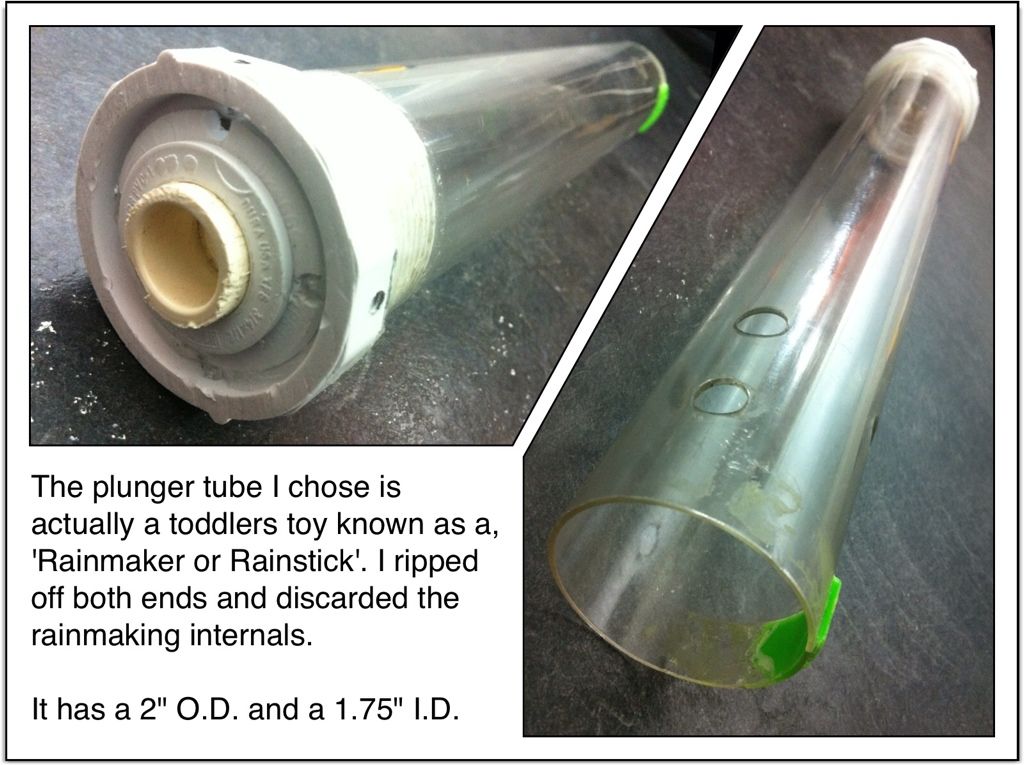
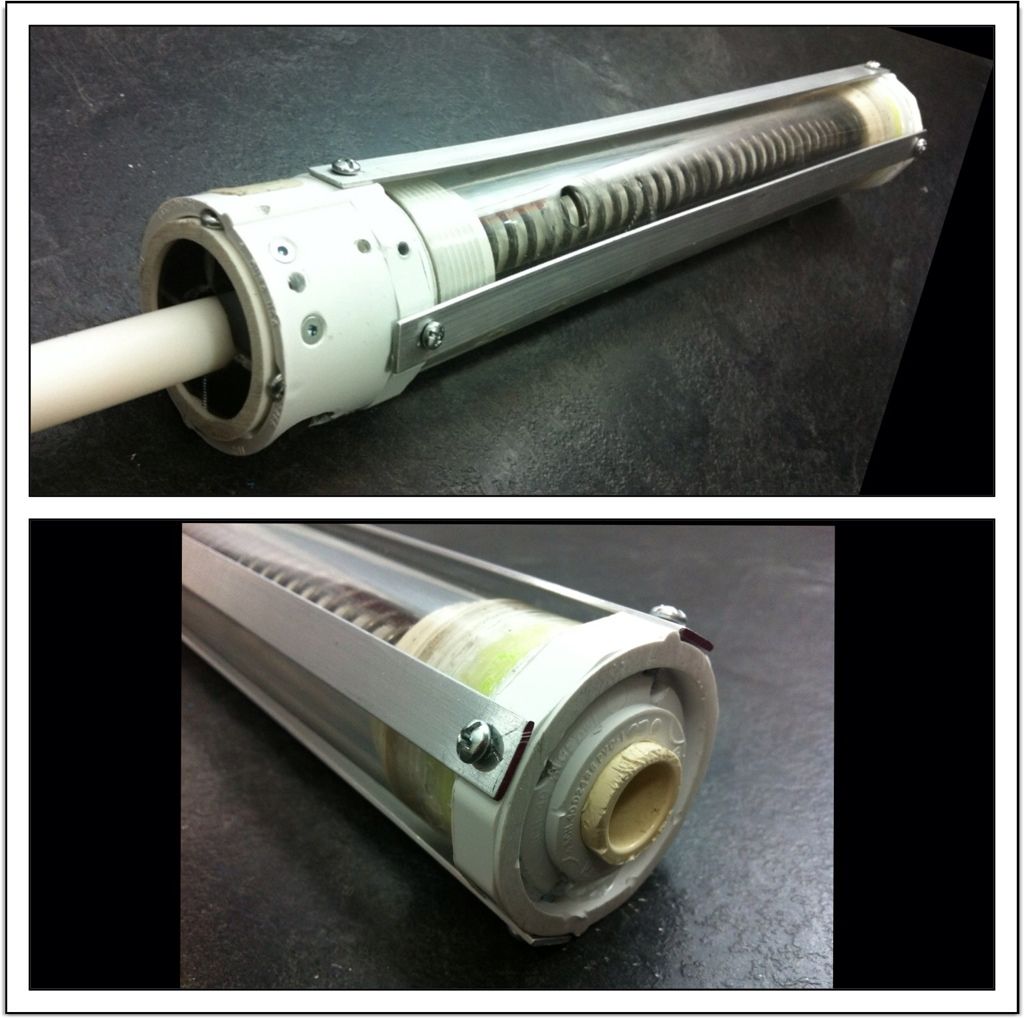
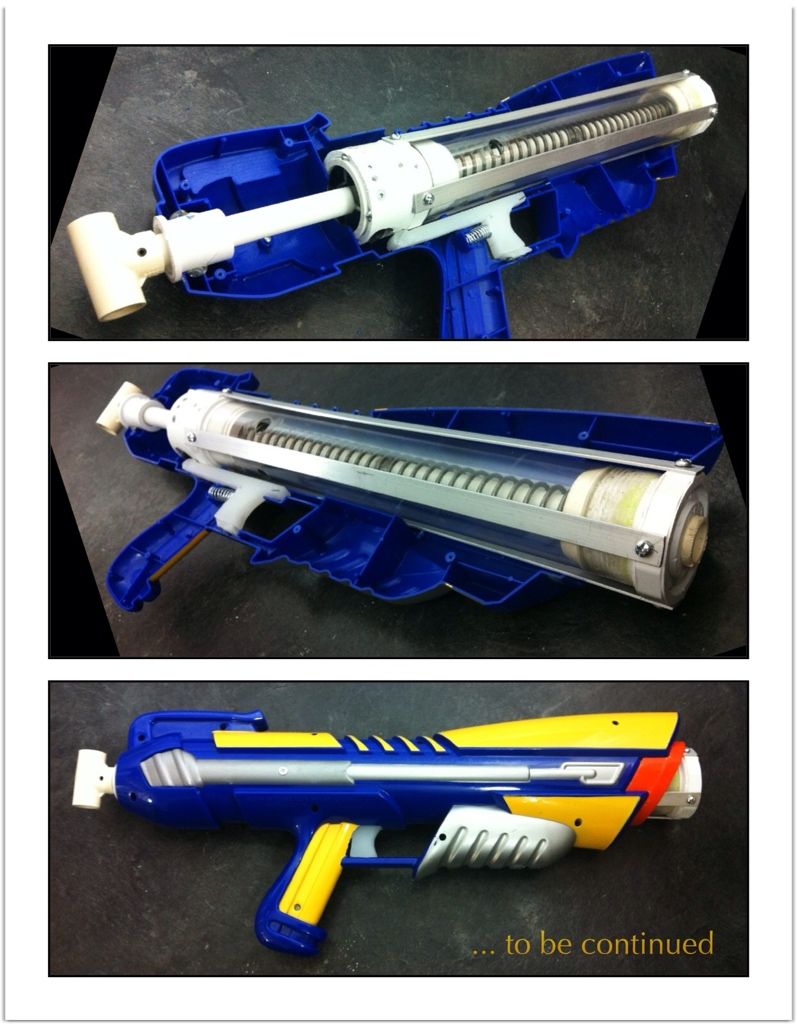
Rainstick/Rainmaker toy as plunger tube.

Posted Image

Posted Image


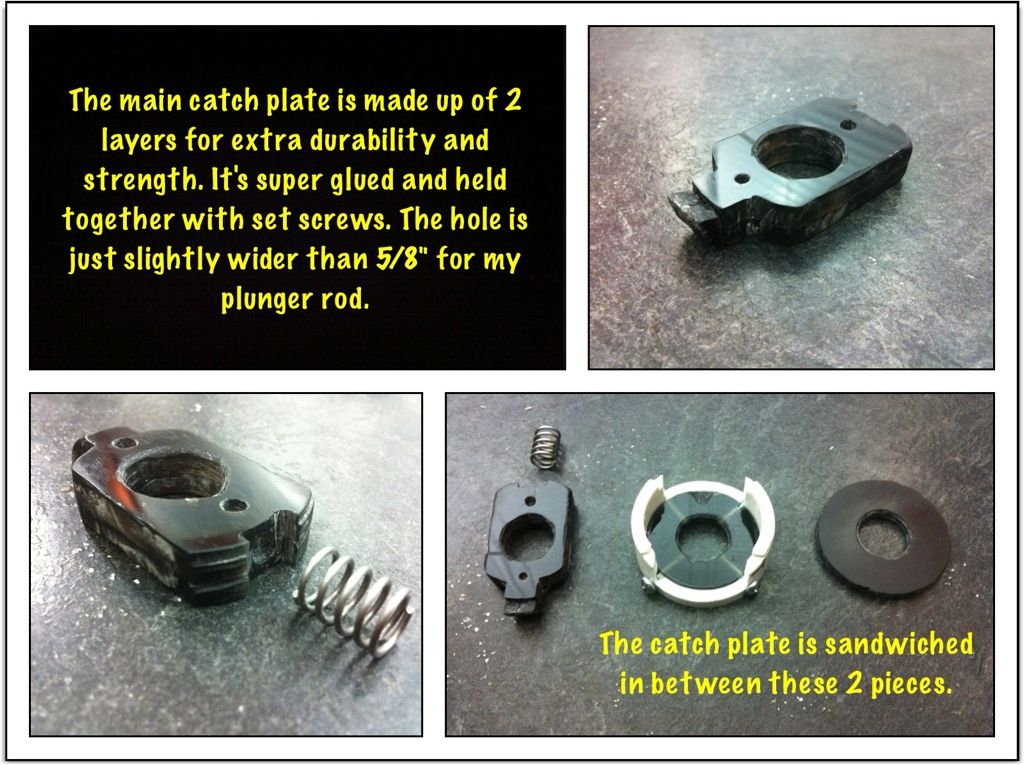
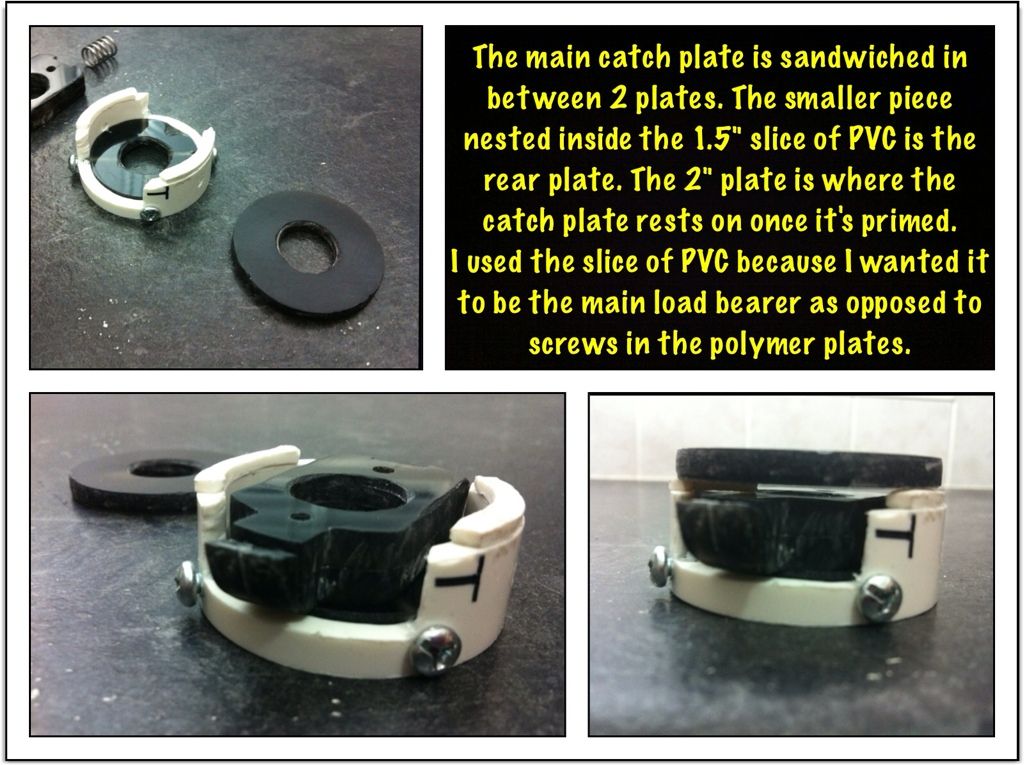
Rainbow Catch Variant.
Posted Image

Posted Image

Posted Image

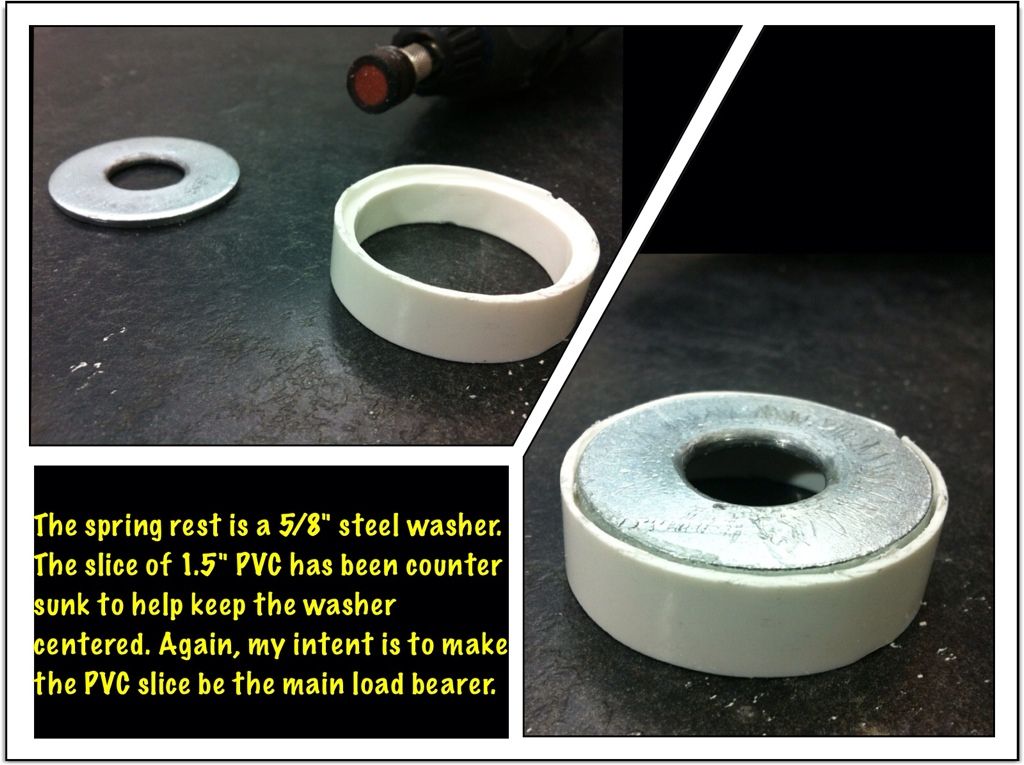
Steel Washer Spring Rest.
Posted Image

Posted Image

Posted Image

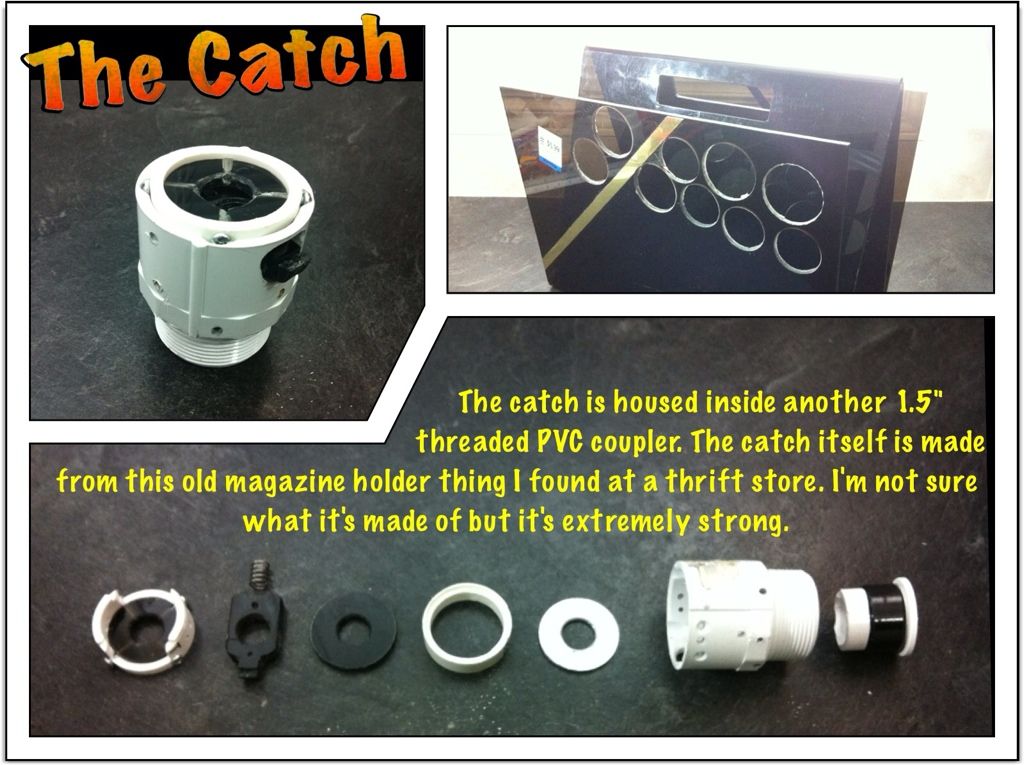
Self Contained Rainbow Catch.
Posted Image

Omni-Directional Slotted PEX Plunger Rod.
Posted Image

Posted Image

Posted Image

Posted Image

Bathtub Plug/ Basin Sink Stopper Plunger head.
Posted Image

Posted Image

Posted Image

Posted Image

Posted Image

Posted Image

Posted Image

Posted Image

Posted Image

Posted Image

http://www.youtube.com/watch?v=J0yjJrVrPo4