The build:
I've never done a real write-up before for this blaster, I think its fairly self explanatory. Let me briefly review what I did.
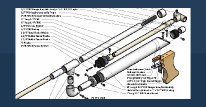
First off, you gotta cut down the shell. I used a dremel and a scroll saw to do this. Just cut in the general pattern that you see here, and remove anything that would obstruct the plunger tube. I suggest using a scrap piece of 1" thinwall to test for clearance.

Plunger tube
You need: 1" Coupler, 1" to 1/2" reducer, 10" of SDR 21 (thinwall) 1" PVC, small metal bar or music wire.
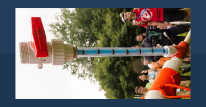
To build the face, take the 1" to 1/2" reducer and look at how the inside is tapered at the end. Cut off that taper so there is a flat surface for the plunger head to contact, as shown below.

Then drill your little hole at the end for your dart stop. I use 7/64" music wire, you can do whatever makes you happy. Below

Done. Now grab up that coupler. There will be a little ledge in there that makes it so the pipe only goes in half way on both sides. Grind that out.

Ledge ^

Ledge gone ^
Now, throw some glue on the reducer and hammer it into one side of the reducer. Take your 10" or so of thinwall PVC and do the same on the opposite side, making sure that the PVC goes all the way through and is touching the back end of the reducer. I messed this up the first time and it was a bitch to prime and got lower ranges.

Plunger head/rod
You need: 3/4" Square nylon: Mcmaster #8732K13, 6-32 tap and #32 bit, 3/4" OD #6 washer: McMaster number 98264A100, aluminum spacer: McMaster #92510A700, Reinforced rubber washer: McMaster # 90131A104, 2" and 3/4" 6-32 screws, nylon or rubber spacers.
Mkay, this is a little more tricky. Get some square nylon, cut it to size according to how long your plunger tube is. Drill and tap one end for #6-32 screws. Then, cut the rubber washer down to fit the 1" thinwall, this is a little tricky, just be patient and measure carefully and you should be able to get a good seal. Then, put the aluminum spacer inside the washer, then assemble in this order over the 3/4" screw: 3/4" washer, rubber washer/aluminum spacer, 3/4" washer. Then screw that onto the plunger rod after putting your spring on. I used a cut down plusbow spring, McMaster #9637K26.

Then, drill and tap a hole on one of the sides at the opposite end. Put the plunger rod through the catch and into the blaster, then put your spacers on the screw and thread it through the hole. This will be your cocking handle.

Then, pull the plunger rod back, full draw, and mark how far the draw was on the rod. Then, take the spring off the rod and one half of the shell off. Place the plunger rod as far back as it went and look at where the catch is touching the rod. Cut your catch notch there. Then put it back together and test it. If it catches, good, if not, try cutting the notch deeper and/or more forward.
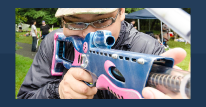
Then, just drill holes to put 2" 6-32 screws through in the back to attach the plunger tube to the shell, and throw some E tape on the front just for extra security. When its all said and done, you should get something that looks like this:

Ranges are similar to previous models, around 90 or 100 feet flat, however this one feels a lot sturdier than previous builds. This is likely the last version of this blaster, I am finally totally satisfied with its construction. Questions, comments, concerns?