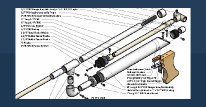
I am trying to do two things: quiet the sound some, and eliminate the stress on the plunger.
Your first goal is achievable. Your second is impossible unless you can rig some magnet-driven, near frictionless plunger setup.
I take it you know how a plunger works. Stress is it the basic princible it works on. Compression and release of a spring pushes the air-tight plunger which compresses the air as it moves. That compressed air then has to push the dart out of the barrel to equalize the pressure.
You cannot take the stress off the plunger. You can only reinforce it. There is no way to lessen the forces acting on the plunger without afffecting the range (Which I assume you want to stay close to what it currently is). For the Longshot, I would suggest doing what many others have done: take two aluminum washers, a neoprene washer, and a heavier screw and replace the plunger head assembly.
You don't have to worry about the plunger shaft breaking. The shaft is essentially a guide. It has very little stress on it. The highest stress point is the connection between the shaft and the plunger head assembly. Reinforce that, and you're set on the durability front.
Now, you're not going to believe this, but try it before you dismiss it: put some FBR between the shaft and the springs. Much of the noise is the springs knocking each other and expanding. Another tip: glue the springs to the back of the plunger face. By doing this, you will eliminate any rattle that goes on, since the springs won't be able to bounce back and forth between the plunger face and the back of the plunger tube.
*Fwheew* That took a long time to type. Hope it helps out a bit. But, realistically, you are not going to get a Longshot very quiet. You'd be better off taking a look at
this. It was a
very quiet rifle when finished. If you want something to fire from a concealed location without detection, don't take a Longshot.
-Pat
Edited by {SF3G}pat 1st Lt., 16 October 2006 - 12:14 PM.