I finished the thing I was talking about on the "Grenade Launcher " thread. So far, testing for single projectiles has gone fairly smoothly; unfortunately, only one solid object has been fired. It was a quarter pound (filled with fired .22WMR casings) pill bottle of medium size. If anyone is a pharmacist here, or knows the actual names for these types of bottels, please correct me. Anyway, it went about forty to fifty feet, or until it struck my shed. Upon being intercepted by this shed, it seperated into two pieces, making it appear as if I spent a day shooting by that shed. This was at about five bar (70-75 psi). Since there were a few gallons of air (pi*1.5^2*48) being released through a rather large (1.5"x4') barrel, this was not amazing and actually quite unimpressive. I will soon be making another few barrels for this for multiple shooting sports. Next is a 1/2" PVC barrel for Nerf, then a 3/4" PVC barrel for Nerf, and, with the aid of a machinist I know, a .24" barrel for airsoft (unrelated to everything else here, I know). If that last barrel works out good, I'll probably have him make me a .5" rifled barrel for Nerfuse also. The barrels will be about eight, four, and ten feet respectively. That half inch one will most likely be the same length as the 1/2" PVC barrel. The lengths are large to make up for the volume of the air tank (stated mathematically previously). I'm probably gonna pick up some more .625", .75", and 1.5" FBR eventually, maybe even .5" if the barrels turn out. I also may make a turret mount for this thing so it can be mounted in a friend's golfcart. Then that would be quite interesting in the woods we just started playing in behind my new house. Right now this thing is about eight feet long due to being inline. It will become O/U on Wed., along with a small leak being fixed on the same day. Pics will be up as soon as I feel like taking them and hosting them through Photobucket. I forgot to mention the valve I used: 1.5" ball.

21 replies to this topic
#1

GeneralPrimevil
-
- Members
- 578 posts
Member
Posted 18 February 2006 - 05:43 PM
"Fear the man with one gun, for he probably knows how to use it."





#3
GeneralPrimevil
-
- Members
- 578 posts
Member
Posted 18 February 2006 - 07:31 PM
A sprinkler valve has too small of porting for my use. Eventually I will figure out how the Supah-Valve is made and create my own version with 2" porting. Until then, 1.5" ball it is.
Wait, by "modded" do you mean pneumatically modifying a diapragm solenoid sprinkler valve so that a small pneumatic valve is opened to cause the pressure on the diaphragm to drop, opening the valve, instead of a solenoid doing the same thing? If so, then I might do that, if I can find a larger irrigation sprinkler valve than one inch, unless I swap to a half inch bore barrel. Then the sprinkler valve might work, but not with any noticeable improvement over the ball valve due to barrel bore, length, etcetera. Although, since pneumatically operated diapragm sprinkler valves open 400 times faster than the same vavle powered by a solenoid, theoretically their may be a noticed increase in distance and report. Then the benefits are worth the $17-24, which is how much I spent all together on this project. I'll post a pic showing its current size later tonight or tomorrow, maybe. Until then, I'll look into the one inch diaphragm valves and see just how to mod them and what the difference is in performance.
Why do so many people hate ball valves? They are good as shutoff valves for filling tanks and for opening bigger valves (like the Supah-Valve).
Wait, by "modded" do you mean pneumatically modifying a diapragm solenoid sprinkler valve so that a small pneumatic valve is opened to cause the pressure on the diaphragm to drop, opening the valve, instead of a solenoid doing the same thing? If so, then I might do that, if I can find a larger irrigation sprinkler valve than one inch, unless I swap to a half inch bore barrel. Then the sprinkler valve might work, but not with any noticeable improvement over the ball valve due to barrel bore, length, etcetera. Although, since pneumatically operated diapragm sprinkler valves open 400 times faster than the same vavle powered by a solenoid, theoretically their may be a noticed increase in distance and report. Then the benefits are worth the $17-24, which is how much I spent all together on this project. I'll post a pic showing its current size later tonight or tomorrow, maybe. Until then, I'll look into the one inch diaphragm valves and see just how to mod them and what the difference is in performance.
Why do so many people hate ball valves? They are good as shutoff valves for filling tanks and for opening bigger valves (like the Supah-Valve).
"Fear the man with one gun, for he probably knows how to use it."
#4
Arcanis
-

- Members
- 240 posts
Member
Posted 18 February 2006 - 07:38 PM
-i hate the yankees as much as the next guy, but i'm only sixteen and i'm not ready for the ice age, or the apocalypse...whichever the great bambino has destined for us. -Rawray7
#5
davidbowie
-
- Members
- 422 posts
Member
Posted 18 February 2006 - 07:54 PM
Arcanis, what the fuck in a baker's shop do you mean by "piston diaphragm"?
It's one or the other. In this case, it's a chamber sealing piston valve built to very high tolerances. Also, it fills from the chamber side rather than the pilot.
As for the sprinkler valve, it really will work with a 1" valve. I have used a similar size chamber, with a 1" UNMODDED sprinkler valve, and a 3'X2.5" barrel to shoot tennis balls farther than what you're saying. Really. It's a huge increase in performance.
If you want an extremely high performance cannon, I suggest you start out with a barrel sealing coaxial piston gun, piloted with a modded sprinkler valve. As a plus, it will look wicked, especially with a turret mount. I've got one with a 3/4" barrel, although I haven't tested it with stefans. I'll post it once I get some minor repairs done.
The problem with coaxial guns is you pretty much have to muzzle load them. Actually, you can use camlocks on the chamber a little ahead of the sealing face of the barrel. I've been thinking about doing it on mine, but I don't want to bother getting camlocks.
It's one or the other. In this case, it's a chamber sealing piston valve built to very high tolerances. Also, it fills from the chamber side rather than the pilot.
As for the sprinkler valve, it really will work with a 1" valve. I have used a similar size chamber, with a 1" UNMODDED sprinkler valve, and a 3'X2.5" barrel to shoot tennis balls farther than what you're saying. Really. It's a huge increase in performance.
If you want an extremely high performance cannon, I suggest you start out with a barrel sealing coaxial piston gun, piloted with a modded sprinkler valve. As a plus, it will look wicked, especially with a turret mount. I've got one with a 3/4" barrel, although I haven't tested it with stefans. I'll post it once I get some minor repairs done.
The problem with coaxial guns is you pretty much have to muzzle load them. Actually, you can use camlocks on the chamber a little ahead of the sealing face of the barrel. I've been thinking about doing it on mine, but I don't want to bother getting camlocks.
Check out the all-new DBNerf. The source for all your DBNeeds.
#6
Pineapple
-
- Contributors
- 1,377 posts
Old-school Admin
Posted 18 February 2006 - 11:14 PM
Mmmm...listen to the SupdFiles guy. 
Yep, they in fact DO have sprinkler valves larger than 1"...it really is limited by what you're willing to invest in.
My newest creation is a typical over/under shooter, 3 feet of 3" SCH40, reduced (yeah, I know, sue me) to 2", through a Hunter ICV diaphragm valve, into a 1 1/2" SCH40 barrel, which so happens to fit golf balls quite nicely. I also crafted a 2" smoothbore barrel (3 1/2 feet long) to fire modified Max Shot bombs (fins trimmed to fit the tube).
The cement is dry, and pressure testing will begin tomorrow morning, weather permitting. Then it'll be time to mount it on a hand truck that I'm converting to trailer use.
I have the valve because I oversee a large property with fully automated irrigation system. I took the "parts" sprinkler body, and pieced the valve together on my own with spring, diaphragm, etc. bought on my own (the originals were cannibalized, as was the solenoid, from the sprinkler).
Normally something like this runs a pretty penny, so I economized by nickel and diming it together from the parts bins (took a couple months to get everything, it wasn't a big priority on my 'to do' list.) And an auto-shop type blow gun is serves as the dump valve to open up the diaphragm. Typical spud gun material. You could probably get away for more than half the price of a new Hunter valve by checking what the spudders use, I know some Rain Bird, Orbit, and other household irrigation valves can be quite a bit cheaper. But you do get what you paid for.
It's muzzle loading, but I'm looking at repair couplings as an inexpensive way to create a sliding breech loader. I know davidbowie will read this so I hope he can shed some insight, as does GeneralPrimevil.
I'm new to artillery too, but my son wanted a Nerf howitzer for Christmas, so this is a bit late. And I promise not to wander too far from "just Nerfing".
-Piney-
Yep, they in fact DO have sprinkler valves larger than 1"...it really is limited by what you're willing to invest in.
My newest creation is a typical over/under shooter, 3 feet of 3" SCH40, reduced (yeah, I know, sue me) to 2", through a Hunter ICV diaphragm valve, into a 1 1/2" SCH40 barrel, which so happens to fit golf balls quite nicely. I also crafted a 2" smoothbore barrel (3 1/2 feet long) to fire modified Max Shot bombs (fins trimmed to fit the tube).
The cement is dry, and pressure testing will begin tomorrow morning, weather permitting. Then it'll be time to mount it on a hand truck that I'm converting to trailer use.
I have the valve because I oversee a large property with fully automated irrigation system. I took the "parts" sprinkler body, and pieced the valve together on my own with spring, diaphragm, etc. bought on my own (the originals were cannibalized, as was the solenoid, from the sprinkler).
Normally something like this runs a pretty penny, so I economized by nickel and diming it together from the parts bins (took a couple months to get everything, it wasn't a big priority on my 'to do' list.) And an auto-shop type blow gun is serves as the dump valve to open up the diaphragm. Typical spud gun material. You could probably get away for more than half the price of a new Hunter valve by checking what the spudders use, I know some Rain Bird, Orbit, and other household irrigation valves can be quite a bit cheaper. But you do get what you paid for.
It's muzzle loading, but I'm looking at repair couplings as an inexpensive way to create a sliding breech loader. I know davidbowie will read this so I hope he can shed some insight, as does GeneralPrimevil.
I'm new to artillery too, but my son wanted a Nerf howitzer for Christmas, so this is a bit late. And I promise not to wander too far from "just Nerfing".
-Piney-
-Piney- of White Dog Hobbies Armory
<!--quoteo(post=209846:date=Feb 5 2009, 06:27 PM:name=boom)--><div class='quotetop'>QUOTE(boom @ Feb 5 2009, 06:27 PM) </div><div class='quotemain'><!--quotec-->
It's to bad you live in hawaii I bet there are not many wars there.Wait what am I saying<b> you live in hawaii you lucky bastard.</b>
<!--QuoteEnd--></div><!--QuoteEEnd-->
<!--quoteo(post=209846:date=Feb 5 2009, 06:27 PM:name=boom)--><div class='quotetop'>QUOTE(boom @ Feb 5 2009, 06:27 PM)
</div><div class='quotemain'><!--quotec-->It's to bad you live in hawaii I bet there are not many wars there.Wait what am I saying<b> you live in hawaii you lucky bastard.</b>
<!--QuoteEnd--></div><!--QuoteEEnd-->
#7
davidbowie
-
- Members
- 422 posts
Member
Posted 19 February 2006 - 02:02 AM
Just because I'm a dick, I have to point out that 1.5" SCH-40 does not actually fit golfballs. You probably have some SDR-21 or SDR-26. That really doesn't matter, though.
It's true, sprinkler valves come bigger than 1". I've seen 3" Irritrols used in cannons before, and a place near me can order them up to, if I recall correctly, 6". That is, if you have a spare arm and leg you can part with.
Looks like you got a great deal on that valve. Another member of spudtech recently got a pair of 1.5" diaphragm valves for $10 each. I'm jealous of both of you.
On to repair couplings: as I said, golfballs don't fit in 1.5" SCH-40 sliding repair couplings have roughly the same ID as the equivalent SCH-40 pipe. So, you must use a 2" repair coupling instead of a 1.5" one.
Repair couplings are great for breech loading. My favorite method for this is to tap a fairly long bolt into the wall of the insert as a handle, then cut the outer part in half so that the insert can come out. Then, use a dremel to cut an L shaped slit for the bolt to pass through, and lock the insert in place.
It's true, sprinkler valves come bigger than 1". I've seen 3" Irritrols used in cannons before, and a place near me can order them up to, if I recall correctly, 6". That is, if you have a spare arm and leg you can part with.
Looks like you got a great deal on that valve. Another member of spudtech recently got a pair of 1.5" diaphragm valves for $10 each. I'm jealous of both of you.
On to repair couplings: as I said, golfballs don't fit in 1.5" SCH-40 sliding repair couplings have roughly the same ID as the equivalent SCH-40 pipe. So, you must use a 2" repair coupling instead of a 1.5" one.
Repair couplings are great for breech loading. My favorite method for this is to tap a fairly long bolt into the wall of the insert as a handle, then cut the outer part in half so that the insert can come out. Then, use a dremel to cut an L shaped slit for the bolt to pass through, and lock the insert in place.
Check out the all-new DBNerf. The source for all your DBNeeds.
#8
GeneralPrimevil
-
- Members
- 578 posts
Member
Posted 19 February 2006 - 07:57 AM
Well, it still is only eleven degrees Farenheit here; I guess that is an improvement over three degrees yesterday. Once the mercury gets beyond twenty, then I'll charge this thing to 100 psi and find out what it can do.
Okay, I now know what I'm going to be doing. For the 3/4 inch bore barrel and smaller, a one inch modified sprinkler valve will be used. Since I am going to be picking up a couple of threaded elbows, one of them just has to be 1.5 inch slip by one inch male threaded, this will be easy to install. The other has to be 1.5 inch slip by 1.5 inch female threaded. Unless I can find a U which is 1.5 inch female threaded by one inch male threaded or if it is 1.5 inch female all around, then use an adapter. Either of the U-connectors would be easier and more reliable. This is because I need this thing to be O/U. Anyway, the sprinler vavle is going to be modified just like it is on SpudFiles, the hose which I'm going to using allows me to remove the pilot vavle since I have many air chuck pieces at my disposal. That is a really nice safety device, although if the pilot valve is removed with the cannon ready to fire, the cannon might fire due to pressure being released when the chuck is operated.
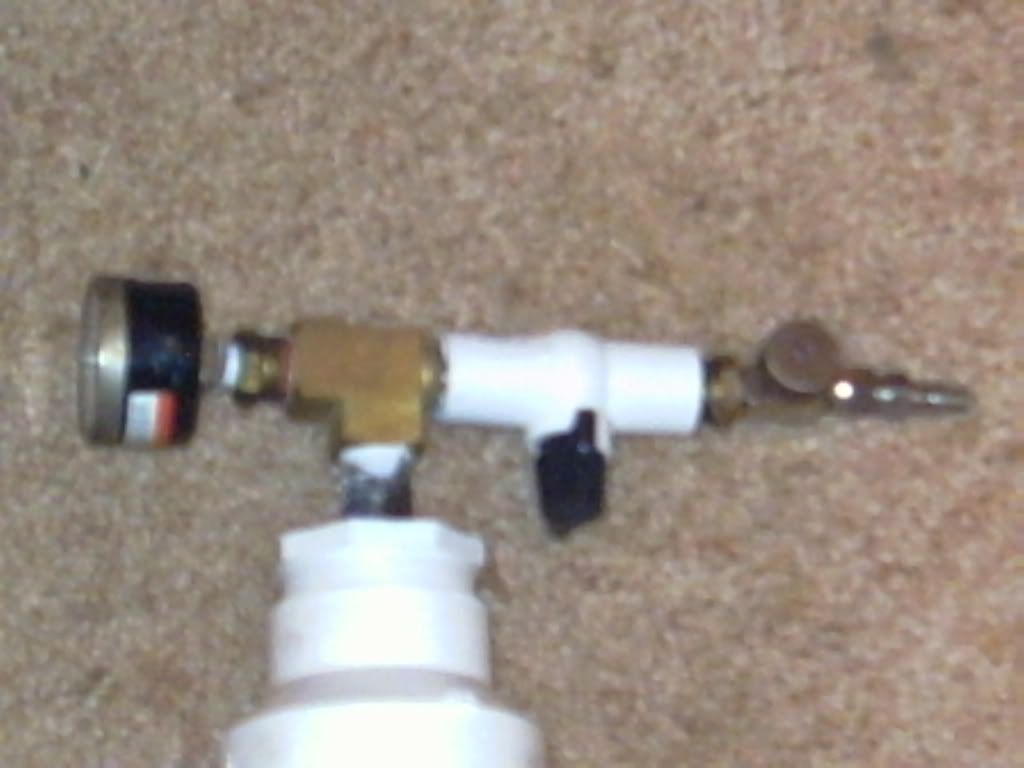
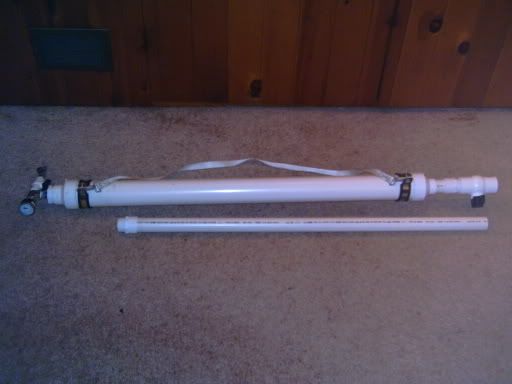
Pictures so far:
Fill valve and reg. That gauge goes up to 300 psi, I use the metric measurements though because they are easier to duplicate in results. I may later swap for a 100 psi gauge, because I can, and it is more precise than all of my otehr gauges at my disposal.
The cannon itself. The barrel is detached so all of it could fit in the picture.
It turns out taht the other person who is footing the bill for this project wants more range, so they want a one inch barrel. Mathematically speaking, for the same volume barrel, won't larger diameter have more power available? Someone prove me wrong, or right, or both.
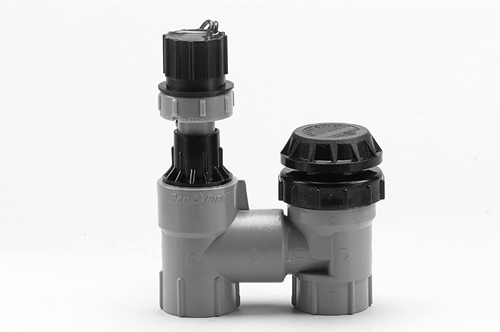
<EDIT> In my quest for a valve, I found something quite interesting (that I plan to not use): This. What is up with it? It is not regular diphragm, so is it piston diaphragm or something else? I don't think it's just regular piston either, because usually that would be trumpet valve like. Which reminds me, a trumpet valve would be great as a pilot valve for a large diaphragm irrigation valve. </EDIT>
Okay, I now know what I'm going to be doing. For the 3/4 inch bore barrel and smaller, a one inch modified sprinkler valve will be used. Since I am going to be picking up a couple of threaded elbows, one of them just has to be 1.5 inch slip by one inch male threaded, this will be easy to install. The other has to be 1.5 inch slip by 1.5 inch female threaded. Unless I can find a U which is 1.5 inch female threaded by one inch male threaded or if it is 1.5 inch female all around, then use an adapter. Either of the U-connectors would be easier and more reliable. This is because I need this thing to be O/U. Anyway, the sprinler vavle is going to be modified just like it is on SpudFiles, the hose which I'm going to using allows me to remove the pilot vavle since I have many air chuck pieces at my disposal. That is a really nice safety device, although if the pilot valve is removed with the cannon ready to fire, the cannon might fire due to pressure being released when the chuck is operated.
Pictures so far:
Fill valve and reg. That gauge goes up to 300 psi, I use the metric measurements though because they are easier to duplicate in results. I may later swap for a 100 psi gauge, because I can, and it is more precise than all of my otehr gauges at my disposal.
The cannon itself. The barrel is detached so all of it could fit in the picture.
It turns out taht the other person who is footing the bill for this project wants more range, so they want a one inch barrel. Mathematically speaking, for the same volume barrel, won't larger diameter have more power available? Someone prove me wrong, or right, or both.
<EDIT> In my quest for a valve, I found something quite interesting (that I plan to not use): This. What is up with it? It is not regular diphragm, so is it piston diaphragm or something else? I don't think it's just regular piston either, because usually that would be trumpet valve like. Which reminds me, a trumpet valve would be great as a pilot valve for a large diaphragm irrigation valve. </EDIT>
Edited by GeneralPrimevil, 19 February 2006 - 08:18 AM.
"Fear the man with one gun, for he probably knows how to use it."
#9
davidbowie
-
- Members
- 422 posts
Member
Posted 19 February 2006 - 11:02 AM
the link to lowe's isn't working.
Can you explain more what it is?
By trumpet valve do you mean the valve on a trumpet?
For the bends: they really don't make U connectors. Your best bet is to use two 1.5" threaded street elbows.
In regards to the barrel size issue: for a given valve and chamber, a smaller diameter barrel will shoot faster. The real issue here is what you want to shoot. If you just want to be launching big darts, then go with 3/4". For other stuff, I'd say go bigger.
You might want to look into a ball barrel.
Can you explain more what it is?
By trumpet valve do you mean the valve on a trumpet?
For the bends: they really don't make U connectors. Your best bet is to use two 1.5" threaded street elbows.
In regards to the barrel size issue: for a given valve and chamber, a smaller diameter barrel will shoot faster. The real issue here is what you want to shoot. If you just want to be launching big darts, then go with 3/4". For other stuff, I'd say go bigger.
You might want to look into a ball barrel.
Check out the all-new DBNerf. The source for all your DBNeeds.
#10
GeneralPrimevil
-
- Members
- 578 posts
Member
Posted 19 February 2006 - 11:33 AM
Hmm...link works for me.
What is currently going to be happening is that the straight design shown in those pictures is going to be converted to an over/under configuration so that this thing isn't eight feet long in battle. I'm just going to use a modified one inch sprinkler valve to fire the thing. The modification will have a removable pilot valve so that people can't shoot it unless I am there. Unless you were talking about the valve I found, in which case, next paragraph.
This link might work, hopefully. The valve has its "in" and "exhaust" on the same side. Just tell me if the link still isn't working since I can't describe it much further without thinking hard.
As for the trumpet valve, yes, an actual trumpet valve with a fitting soldered/welded (with the core removed, of course) to a hole on the valve body. I am not saying that I will be using a trumpet valve because I'd use the rotarty valve off of a tuba.
I have seen U pipes in three inch Sch40 a couple of times. Since I am going to Lowes today, I might as well check out some stuff, maybe bring a camera.
Darts are going to be one of the projectiles for one of the barrels.
Ball barrel as in shoots Nerf balls? Hmm...
What is currently going to be happening is that the straight design shown in those pictures is going to be converted to an over/under configuration so that this thing isn't eight feet long in battle. I'm just going to use a modified one inch sprinkler valve to fire the thing. The modification will have a removable pilot valve so that people can't shoot it unless I am there. Unless you were talking about the valve I found, in which case, next paragraph.
This link might work, hopefully. The valve has its "in" and "exhaust" on the same side. Just tell me if the link still isn't working since I can't describe it much further without thinking hard.
As for the trumpet valve, yes, an actual trumpet valve with a fitting soldered/welded (with the core removed, of course) to a hole on the valve body. I am not saying that I will be using a trumpet valve because I'd use the rotarty valve off of a tuba.
I have seen U pipes in three inch Sch40 a couple of times. Since I am going to Lowes today, I might as well check out some stuff, maybe bring a camera.
Darts are going to be one of the projectiles for one of the barrels.
Ball barrel as in shoots Nerf balls? Hmm...
"Fear the man with one gun, for he probably knows how to use it."
#11
davidbowie
-
- Members
- 422 posts
Member
Posted 19 February 2006 - 12:18 PM
Yeah, I got the first bit from the last post, but the second paragraph was what I needed. Thanks.
Yes, I've seen those valves around. From what I remember the flow isn't as good as an inline, and they're hard to modify. They are diaphragm valves.
I've seen occasional U fittings, but they tend to be non-rated U traps. Just check whatever you end up with for a pressure rating, or nsf-pw.
If you do end up with a ball barrel, there are many things you can do with it. Before I get into that, though, I have to ask what your air source will be in battles. Try to get a compressor (NOT an emergency compressor or inflator) that you can put in the golf cart with you.
So, now to the ball barrel stuff: You should definitely have a clip feed. You can have a reciprocating bolt for bolt action, or work out something a bit more complicated for semi auto. A direct clip or hopper feeding straight into the barrel will provide a superfast full auto, but you wouldn't be able to sustain it for long.
Also, you should put in a hop-up. It would solve, at least partially, the issue os nerf balls being the least accurate ammo.
Yes, I've seen those valves around. From what I remember the flow isn't as good as an inline, and they're hard to modify. They are diaphragm valves.
I've seen occasional U fittings, but they tend to be non-rated U traps. Just check whatever you end up with for a pressure rating, or nsf-pw.
If you do end up with a ball barrel, there are many things you can do with it. Before I get into that, though, I have to ask what your air source will be in battles. Try to get a compressor (NOT an emergency compressor or inflator) that you can put in the golf cart with you.
So, now to the ball barrel stuff: You should definitely have a clip feed. You can have a reciprocating bolt for bolt action, or work out something a bit more complicated for semi auto. A direct clip or hopper feeding straight into the barrel will provide a superfast full auto, but you wouldn't be able to sustain it for long.
Also, you should put in a hop-up. It would solve, at least partially, the issue os nerf balls being the least accurate ammo.
Check out the all-new DBNerf. The source for all your DBNeeds.
#12
GeneralPrimevil
-
- Members
- 578 posts
Member
Posted 19 February 2006 - 04:49 PM
I'll probably run something like a T-fitting with a threaded top or something. I have all of the stuff to make a spring loaded mag that could be threaded into it. Then the force of the spring might counter the force of the air, but then the Nerf balls would be squished. Otherwise a cap could be used for single shot work.
For the air source, I'll probably just keep the twenty gallon compressor I have in the cart. That holds enough pressure for about 5 shots, first at 100 psi, second at around 90, and so on. If I could use 60-70 psi per shot, the air filling the tank can be double regulated: one at the compresor, one at the base of the tank. I would have almost twice as many shots then. What diameter are the balls? I might start work on making a barrel for them. Perhaps an oversized O-ring hop-up?
As I was looking around at a few places today, I've decided to just go with two elbows, not a U-fitting. All will be threaded to keep this thing modular. Three elbows all together will be purchsed: two 1.5"x1.5" threaded female-male and one 1.5"x1" female-male.
Oh yeah, one more thing; the inlet to the tank on this cannon is not a schrader valve, (check the pic) so I can't use an emergency compressor anyway without a bit of modification. It is the same thing found on airtools in a shop. It hooks directly to the air chuck on my shop compressor.
Perhaps a specialized cannon is required for the cart. I wonder what would happen if I used about four feet of hose connecting my compressor to a valve attached to a barrel, what it would produce practicality-wise and performance-wise. If the balls are about an inch in diameter, that could work well, maybe. It would be easier to fit in the cart, that's for sure.
<EDIT> Reword, didn't accurately portray what I was thinking.</EDIT>
For the air source, I'll probably just keep the twenty gallon compressor I have in the cart. That holds enough pressure for about 5 shots, first at 100 psi, second at around 90, and so on. If I could use 60-70 psi per shot, the air filling the tank can be double regulated: one at the compresor, one at the base of the tank. I would have almost twice as many shots then. What diameter are the balls? I might start work on making a barrel for them. Perhaps an oversized O-ring hop-up?
As I was looking around at a few places today, I've decided to just go with two elbows, not a U-fitting. All will be threaded to keep this thing modular. Three elbows all together will be purchsed: two 1.5"x1.5" threaded female-male and one 1.5"x1" female-male.
Oh yeah, one more thing; the inlet to the tank on this cannon is not a schrader valve, (check the pic) so I can't use an emergency compressor anyway without a bit of modification. It is the same thing found on airtools in a shop. It hooks directly to the air chuck on my shop compressor.
Perhaps a specialized cannon is required for the cart. I wonder what would happen if I used about four feet of hose connecting my compressor to a valve attached to a barrel, what it would produce practicality-wise and performance-wise. If the balls are about an inch in diameter, that could work well, maybe. It would be easier to fit in the cart, that's for sure.
<EDIT> Reword, didn't accurately portray what I was thinking.</EDIT>
Edited by GeneralPrimevil, 19 February 2006 - 05:06 PM.
"Fear the man with one gun, for he probably knows how to use it."
#13
davidbowie
-
- Members
- 422 posts
Member
Posted 19 February 2006 - 06:07 PM
Here's something to think about: having a clip going directly into the barrel, with nothing to regulate it (like a bolt), will make FULL auto. Just so you know. If the barrel isn't blocked, the air will actually pull the balls into the barrel, not squish them against the spring. ROF will be extremely fast, so with any manageable clip size it will be more like a shotgun than a machine gun.
Ah yes. QD's. I love them. I use them pretty much exclusively on cannons now, because they're cheaper, more available, and generally work better than schraders. I have a bike pump modded for a male QD output, and it's quite handy.
Do you mean you'll use the compressor as a tank, or actually have it powered as you drive around?
As for directly connecting air hose to a valve, I would say no. A chamber doesn't have to be huge. A 1.5" chamber and a 1" barrel, both the same length, in over under configuration, will work fine, and it's not that bulky.
Ah yes. QD's. I love them. I use them pretty much exclusively on cannons now, because they're cheaper, more available, and generally work better than schraders. I have a bike pump modded for a male QD output, and it's quite handy.
Do you mean you'll use the compressor as a tank, or actually have it powered as you drive around?
As for directly connecting air hose to a valve, I would say no. A chamber doesn't have to be huge. A 1.5" chamber and a 1" barrel, both the same length, in over under configuration, will work fine, and it's not that bulky.
Check out the all-new DBNerf. The source for all your DBNeeds.
#14
GeneralPrimevil
-
- Members
- 578 posts
Member
Posted 19 February 2006 - 06:33 PM
I know that it would be full auto, and quite fast. What I meant by squishing was the spring against the balls, not the air against the balls against the spring.
The compressor will be a secondary tank for the express purpose of filling the primary tank which is attached to the barrel.
STOP...Before one proceeds, read this first: Perhaps I should figure out WHAT I am going to build (first step in the Universal Systems Model) before I figure out the best possible way of doing it.../STOP
If I really wanted to, I could run metered propane. Then I wouldn't have to worry much about a massive tank to fill a chamber. All that I have to buy in order to run propane (on a new launcher) is the PVC and a few fittings, which I have to pick up anyway. I think that while I make more barrels, I'll start work on this Nerf ball gun. First I have to do the math to make the propane meter put in the right amount.
Let me get the total picture here:
Propane combustion powered with 1.5:1 ratio, dual ignition, chamber is 2 or 3" (preferably 3, since I have about 6 feet left over) PVC, inline or O/U, T-fitting for the breach, barrel length of 2.5', barrel bore of 1", hop-up.
That could be the smallest package I could think of that still has quite a bit of power. Dual ignition, however, with only one peizo (sp?) ignitor might be a bit bad, no? Ins't that how it's supposed to be done? I haven't really messed with that stuff before.
I think a Zero breach would be a nice add on for this thing. Then it could be an ultra-long range rifle. What weight would the mega Stefans be then? 1/4 oz.?
The compressor will be a secondary tank for the express purpose of filling the primary tank which is attached to the barrel.
STOP...Before one proceeds, read this first: Perhaps I should figure out WHAT I am going to build (first step in the Universal Systems Model) before I figure out the best possible way of doing it.../STOP
If I really wanted to, I could run metered propane.
Then I wouldn't have to worry much about a massive tank to fill a chamber. All that I have to buy in order to run propane (on a new launcher) is the PVC and a few fittings, which I have to pick up anyway. I think that while I make more barrels, I'll start work on this Nerf ball gun. First I have to do the math to make the propane meter put in the right amount.Let me get the total picture here:
Propane combustion powered with 1.5:1 ratio, dual ignition, chamber is 2 or 3" (preferably 3, since I have about 6 feet left over) PVC, inline or O/U, T-fitting for the breach, barrel length of 2.5', barrel bore of 1", hop-up.
That could be the smallest package I could think of that still has quite a bit of power. Dual ignition, however, with only one peizo (sp?) ignitor might be a bit bad, no? Ins't that how it's supposed to be done? I haven't really messed with that stuff before.
I think a Zero breach would be a nice add on for this thing. Then it could be an ultra-long range rifle. What weight would the mega Stefans be then? 1/4 oz.?
Edited by GeneralPrimevil, 19 February 2006 - 07:29 PM.
"Fear the man with one gun, for he probably knows how to use it."
#15
davidbowie
-
- Members
- 422 posts
Member
Posted 19 February 2006 - 07:27 PM
The most efficient C:B ratio for propane is .7:1, so you could go with a longer barrel with the same chamber size.
For portability, propane really is the best way to go. See: Tipmann C-3
For portability, propane really is the best way to go. See: Tipmann C-3
Check out the all-new DBNerf. The source for all your DBNeeds.
#16
GeneralPrimevil
-
- Members
- 578 posts
Member
Posted 19 February 2006 - 07:48 PM
Then propane it is. Work will commence on Wednesday, starting with purchasing whatever I can't find at my local school's bus depot. Pretty much, I'll need to buy another length of 1" Sch40 and a few Sch40 fittings. Instead of a 2.5' barrel and 6" of 3" pipe for the chamber (~1.7:1), I'll run 4' with the same chamber, like you said. That'll be a bit closer to .7:1 at about 1.1:1. The propane meter only needs to have about 1.5-2" of 1/2" pipe, which gives about 5-7% propane in the chamber. This is a bit rich, but not to bad.
Dual ignition is still on the list, along with sights and a pistolgrip. This thing will be inline configuration. The pintel mount will be attached probably via some worm drive tubing clamps on the T-fitting breach hole. A custom wrench will be attached to the threaded stop on the breach as well. That way it is easier to remove. A breech stop is needed, so how about a 1/4"x20 bolt tapped through the T just behind the hole?
Even though there is little reason, should the rear of the chamber still be removable? It offers better cooling, so yes? With it removeable, I could use an aerosal if I don't feel the need to use propane. However, propane is necessary because I live in Michigan, where we play wargames even down to zero degrees Farenheit.
Dual ignition is still on the list, along with sights and a pistolgrip. This thing will be inline configuration. The pintel mount will be attached probably via some worm drive tubing clamps on the T-fitting breach hole. A custom wrench will be attached to the threaded stop on the breach as well. That way it is easier to remove. A breech stop is needed, so how about a 1/4"x20 bolt tapped through the T just behind the hole?
Even though there is little reason, should the rear of the chamber still be removable? It offers better cooling, so yes? With it removeable, I could use an aerosal if I don't feel the need to use propane. However, propane is necessary because I live in Michigan, where we play wargames even down to zero degrees Farenheit.
"Fear the man with one gun, for he probably knows how to use it."
#17
davidbowie
-
- Members
- 422 posts
Member
Posted 19 February 2006 - 08:04 PM
First off, I would recommend NOT using a PVC cannon in the cold. PVC gets very brittle in the cold, and it's much more likely to grenade.
three things:
1) Chamber fan: Aids in mixing of fuel. Not necessary, but it does help.
2) Venting: A removable end cap is a good thing to have, because you're going to need to vent out your chamber. An even better way is a high-volume blower such as a mattress inflator, running through a check valve into your chamber, to vent spent fuel at the push of a button.
3) Regulator: I would suggest using a regulator for your propane meter. Use FuelTool to calculate your meter pipe.
three things:
1) Chamber fan: Aids in mixing of fuel. Not necessary, but it does help.
2) Venting: A removable end cap is a good thing to have, because you're going to need to vent out your chamber. An even better way is a high-volume blower such as a mattress inflator, running through a check valve into your chamber, to vent spent fuel at the push of a button.
3) Regulator: I would suggest using a regulator for your propane meter. Use FuelTool to calculate your meter pipe.
Check out the all-new DBNerf. The source for all your DBNeeds.
#18
GeneralPrimevil
-
- Members
- 578 posts
Member
Posted 20 February 2006 - 06:13 AM
Yeah, PVC is fine 'til about, oh, say 10 degrees. Then keep pressure down to 20 psi. Even still, it doesn't grenade (maybe with combustion it does...I'll have to find out), it usually splits on the weakest side and some fragments will appear.
Actually, I may still have some galvanized pipe in 3" OD and 6" OD (old fence posts). I think I have about 50' of both. There may even be some pipe lying around (in fairly great condition) in the scrap steel bins. I know they have 1.25" OD exhaust pipe, which is kinda close to 1" ID. I'm not quite sure how to insulate the bolts (that conduct the spark) from the pipe though, unless I used double-threaded nylon inserts.
I was thinking about a chamber fan, but I wan't really sure what it was until I just Googled it. I'll just yank that 80mm fan from that old power supply I have lying around...
Yeah, with the steel pipe, it would be muzzle loaded and probably have no easy way of a removable end cap. Unless I somehow secured a small length of 3" PVC (it is a tight fit) on the back of this and used PVC fittings for the plug-cap. That defeats the purpose of the steel pipe almost.
As for a reg, how about the one for those mini-propane torches? The thing used for soldering without electricity, or for pipes. I have a few of those lying around also. Come to think of it, I have a lot of stuff lying around.
And what was that Tipmann C-3 about?
FuelTool has the 1/2" pipe actually at 5/8" ID due to plumbing being weird, right? If so, then an inch of pipe is all I need for the PVC. I'll figure it for the steel pipe later today. Better yet, use a smaller diameter pipe for the meter. That way I don't have to have a really little piece of pipe, and I have valves then too. Apparently, I just found out, I have no 1/2" valves, so what I do have is what I'll use for pipe.
Actually, I may still have some galvanized pipe in 3" OD and 6" OD (old fence posts). I think I have about 50' of both. There may even be some pipe lying around (in fairly great condition) in the scrap steel bins. I know they have 1.25" OD exhaust pipe, which is kinda close to 1" ID. I'm not quite sure how to insulate the bolts (that conduct the spark) from the pipe though, unless I used double-threaded nylon inserts.
I was thinking about a chamber fan, but I wan't really sure what it was until I just Googled it. I'll just yank that 80mm fan from that old power supply I have lying around...
Yeah, with the steel pipe, it would be muzzle loaded and probably have no easy way of a removable end cap. Unless I somehow secured a small length of 3" PVC (it is a tight fit) on the back of this and used PVC fittings for the plug-cap. That defeats the purpose of the steel pipe almost.
As for a reg, how about the one for those mini-propane torches? The thing used for soldering without electricity, or for pipes. I have a few of those lying around also. Come to think of it, I have a lot of stuff lying around.
And what was that Tipmann C-3 about?
FuelTool has the 1/2" pipe actually at 5/8" ID due to plumbing being weird, right? If so, then an inch of pipe is all I need for the PVC. I'll figure it for the steel pipe later today. Better yet, use a smaller diameter pipe for the meter. That way I don't have to have a really little piece of pipe, and I have valves then too. Apparently, I just found out, I have no 1/2" valves, so what I do have is what I'll use for pipe.
Edited by GeneralPrimevil, 20 February 2006 - 06:15 AM.
"Fear the man with one gun, for he probably knows how to use it."
#19
davidbowie
-
- Members
- 422 posts
Member
Posted 20 February 2006 - 11:53 AM
It's not guaranteed that a PVC cannon will grenade in the cold, it's just a lot less safe. You can go ahead and use it if you want, just try to keep it as warm as possible.
Combustion puts a lot less stress on the pipe than compressed air.
By regulator, I mean a pressure regulator, not a flow regulator. You can get an air compressor replacement reg for 10-20 bucks.
If you don't want a meter that short, use the regulator to get the pressure down to, say, 30 psi instead of the 90 psi you get with unregulated propane. Try running fueltool again with different pressure.
The Tipmann C-3 runs off propane. It gets 50,000 shots off a torch tank.
Combustion puts a lot less stress on the pipe than compressed air.
By regulator, I mean a pressure regulator, not a flow regulator. You can get an air compressor replacement reg for 10-20 bucks.
If you don't want a meter that short, use the regulator to get the pressure down to, say, 30 psi instead of the 90 psi you get with unregulated propane. Try running fueltool again with different pressure.
The Tipmann C-3 runs off propane. It gets 50,000 shots off a torch tank.
Check out the all-new DBNerf. The source for all your DBNeeds.
#20
GeneralPrimevil
-
- Members
- 578 posts
Member
Posted 20 February 2006 - 03:43 PM
I have an abundance of pressure regs at my disposal, it just depends on how far the reg has to go down. For that big of a drop, I probably will use the largest regulator I have, which also has a maximum pressure of about 500 psi. I won't need it to go that high, but it can take that pressure and bring it down to 0 psi, or 100% reduction. It works almost as a shutoff if need be. However, it takes more than a hundred turns to get it closed. It was made for high pressure air compressor use. It has 1/2" female inlet and outlet, so I will probably use a reducer and get it down to say 3/8" since I have a few valves in that size.
I think that the combustion design would now be something like:
I should be fine though if the barrel is the only thing that is PVC. The chamber has the highest (direct) pressure levels anyway. That and, if you really think about it, the combustion should keep the barrel pretty warm, as long as I leave the thing in a heated area when not in use during the winter.
Time to make an actual image of it, no? Not just the 7-dimensional image in my head?
<EDIT> I realized why the Supah was called a "piston diaphragm" valve: the diaphragm was replaced by a piston. Yeah, that took only a day or so. Also, I might bring up the idea of making a Supah-like valve. It will be a bit different for obvious reasons. That way, our next pneumatic cannon will be extra powerful. Another add-on: the R-clip. That would work pretty good, also. Perhaps I should search for a 1" threaded Y-fitting instead of a T-fitting. Pick up a couple for my Zero/Unknown breach, then use magazines.</EDIT>
I think that the combustion design would now be something like:
- .95:1 ratio
- inline
- 1"x4' Sch40 barrel with T-breach
- 2.75"x6" galvanized steel chamber
- single/dual ignition
- chamber fan
- two handles
- non-QD endcap
- propane reg'd to 30 psi with meter (4.5" of 3/8" pipe) for ~4.5%
- QR pintel mount
- buttplate for shoulder firing (yes, I am fairly crazy)
- 1" threaded adapter
- 1" Sch40 PVC
- 1" T-fitting (slip thread slip)
- fill a propane tank, unless I can find that Coleman campgrill tank somewhere...
I should be fine though if the barrel is the only thing that is PVC. The chamber has the highest (direct) pressure levels anyway. That and, if you really think about it, the combustion should keep the barrel pretty warm, as long as I leave the thing in a heated area when not in use during the winter.
Time to make an actual image of it, no? Not just the 7-dimensional image in my head?
<EDIT> I realized why the Supah was called a "piston diaphragm" valve: the diaphragm was replaced by a piston. Yeah, that took only a day or so. Also, I might bring up the idea of making a Supah-like valve. It will be a bit different for obvious reasons. That way, our next pneumatic cannon will be extra powerful. Another add-on: the R-clip. That would work pretty good, also. Perhaps I should search for a 1" threaded Y-fitting instead of a T-fitting. Pick up a couple for my Zero/Unknown breach, then use magazines.</EDIT>
Edited by GeneralPrimevil, 20 February 2006 - 05:12 PM.
"Fear the man with one gun, for he probably knows how to use it."
#21
davidbowie
-
- Members
- 422 posts
Member
Posted 20 February 2006 - 06:26 PM
First off, I gotta address the edit. What are you trying to say? It's just a plain old piston valve. If you're saying it operates like a diaphragm with a piston, then all piston valves would be called piston diaphragms. My best guess is that it was late at the time.
That steel chamber will be pretty heavy, but go ahead if you want. How do you plan to go about igniting it. Sparkplugs?
You also have to think about how you will vent the chamber after each shot, with a non-removeable endcap.
I highly suggest you join the Spudtech forums, at forums.spudtech.com
I'm not really big into combustions, so the rest of spudtech might be more helpful.
That steel chamber will be pretty heavy, but go ahead if you want. How do you plan to go about igniting it. Sparkplugs?
You also have to think about how you will vent the chamber after each shot, with a non-removeable endcap.
I highly suggest you join the Spudtech forums, at forums.spudtech.com
I'm not really big into combustions, so the rest of spudtech might be more helpful.
Check out the all-new DBNerf. The source for all your DBNeeds.
#22
GeneralPrimevil
-
- Members
- 578 posts
Member
Posted 20 February 2006 - 06:51 PM
I did join, in fact, here is a post that I put on one of the weirder topics to help someone out, kinda...here. My post is on the second page. I still have to finish the CAD images. I probably will after I get a new CAD program.
Eyeah, about that, I hadn't really thought about that when I posted that edit. It was my equivalent to being late at night, though; I just got home from school. That and aren't piston valves more like trumpet valves with a barrier that moves when a stem is depressed, opening the valve? See here. Ah, my early years. How they sucked. I can't believe I posted a napkin drawing.
Time to solve two problems with one solution: use a short piece of 3" PVC bolted to the steel with a threaded adapter and endcap in order to get a good removeable endcap for venting. Then, run electrodes through the PVC since it is electrically nonconductive. That would put the spark further in the chamber and be better than using the double tapped nylon inserts. However, I'd only have single ignition. Na ja.
Edit: Not using the PVC...going with flanges. 1.25" thread for the vent and 1" for the barrel, bolting 'em to steel plate and welding them up to the pipe. There will be a chamber fan, also the ignition is single, maybe dual, sparkplugs, since there is no need for them to be insulated from the pipe. A small motorcycle battery is going to be powering the coil(s), so that will also be used for the fan. Not only that, but the valves on the meter are solenoig operated, using a three-way momentary toggle switch. Firing is controlled by a pushbutton momentary. Fan is a two-way constant rocker switch. I couldn't do much with this yesterday except for over engineer it out of proportion. I'm creating a new topic when this is completed...'cause no one reads this one.
Eyeah, about that, I hadn't really thought about that when I posted that edit. It was my equivalent to being late at night, though; I just got home from school. That and aren't piston valves more like trumpet valves with a barrier that moves when a stem is depressed, opening the valve? See here. Ah, my early years. How they sucked. I can't believe I posted a napkin drawing.
Time to solve two problems with one solution: use a short piece of 3" PVC bolted to the steel with a threaded adapter and endcap in order to get a good removeable endcap for venting. Then, run electrodes through the PVC since it is electrically nonconductive. That would put the spark further in the chamber and be better than using the double tapped nylon inserts. However, I'd only have single ignition. Na ja.
Edit: Not using the PVC...going with flanges. 1.25" thread for the vent and 1" for the barrel, bolting 'em to steel plate and welding them up to the pipe. There will be a chamber fan, also the ignition is single, maybe dual, sparkplugs, since there is no need for them to be insulated from the pipe. A small motorcycle battery is going to be powering the coil(s), so that will also be used for the fan. Not only that, but the valves on the meter are solenoig operated, using a three-way momentary toggle switch. Firing is controlled by a pushbutton momentary. Fan is a two-way constant rocker switch. I couldn't do much with this yesterday except for over engineer it out of proportion. I'm creating a new topic when this is completed...'cause no one reads this one.
Edited by GeneralPrimevil, 23 February 2006 - 05:15 AM.
"Fear the man with one gun, for he probably knows how to use it."
1 user(s) are reading this topic
0 members, 1 guests, 0 anonymous users